
Standard Padel Court vs. Panoramic Court With Roof: Which One Fits Your Project?
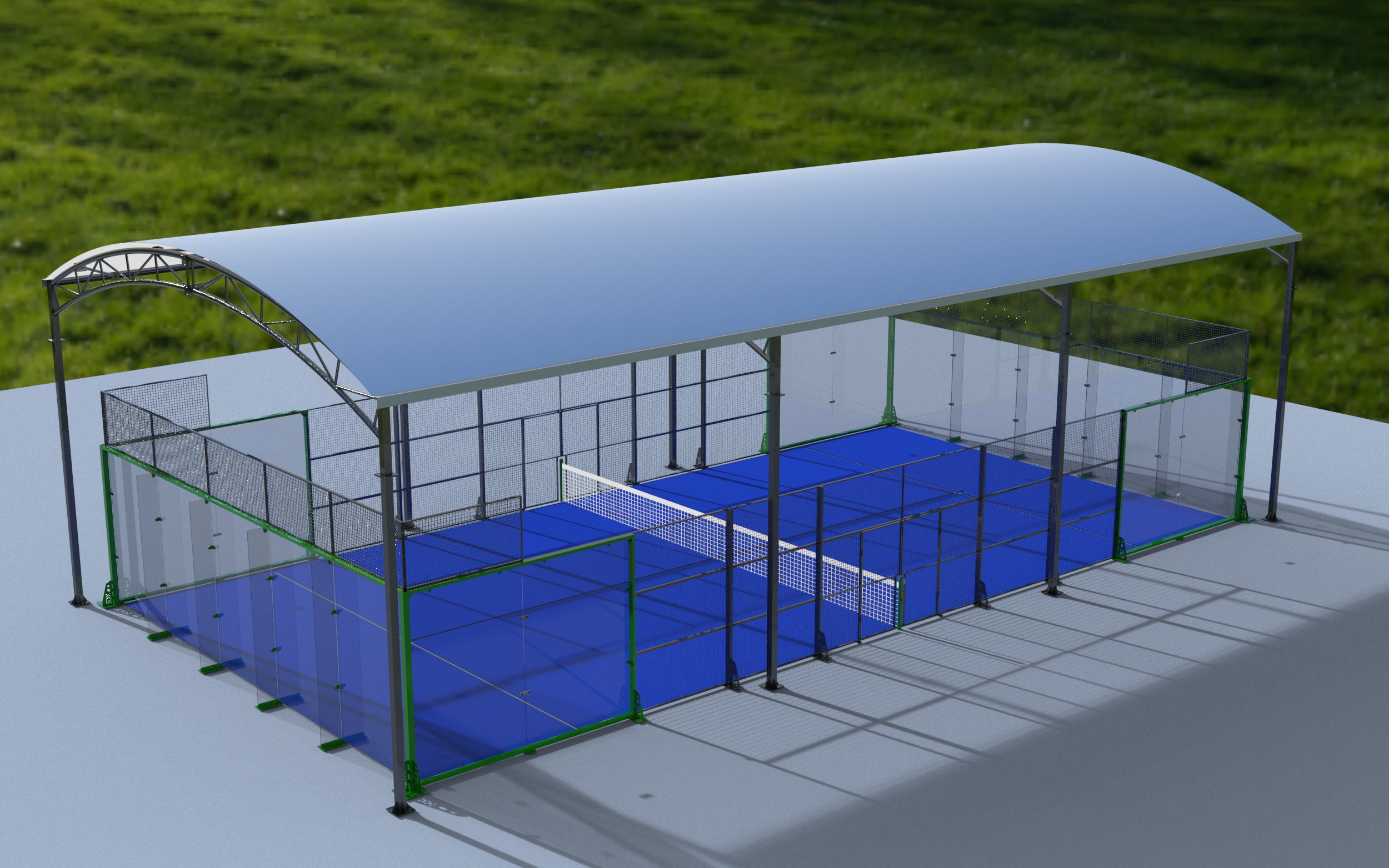
Short answer: Both configurations deliver a regulation 20m × 10m padel court. What changes is the enclosure, the roof structure, and the life-cycle economics around them. An open standard court such as the LDK-PD01 fits mild, low-wind sites and indoor halls where a roof already exists. A panoramic padel court with roof such as the LDK-PADEL-RF01 fits coastal, high-rainfall or high-heat sites, all-weather commercial clubs, and projects where booked hours — not land — are the limiting factor.
Choosing between a standard padel court and a panoramic court with roof is a decision that gets locked in long before the first column is bolted to the slab. It is decided by rainfall days, wind exposure, site height limits, and the number of playing hours the venue expects to sell each week. Once civil works start, changing the answer is expensive.
This guide is written for facility investors, contractors and procurement managers who are in the evaluation stage and must commit to one configuration. It compares the two systems built by SHENZHEN LDK INDUSTRIAL CO., LTD. — the LDK-PD01 open padel court and the LDK-PADEL-RF01 panoramic padel court with roof — on climate fit, site constraints, documentation, cost drivers and lead time, and closes with a scenario table so you can match court type to your project profile.
Problem Definition: What You Are Actually Choosing Between
The decision is rarely about the sport. FIP (International Padel Federation) defines the playing area as 20m × 10m with a 0.5% tolerance, and both LDK systems are built to that footprint. The real variables sit around the court:
- Weather exposure — an open court stops earning during rain, and in hot climates daytime hours become unplayable without shading.
- Site constraints — a roofed court is a structural building. It needs vertical clearance, a column grid, and foundation capacity.
- Usage intensity — the more hours a venue expects to sell per week, the more a roof converts lost hours into revenue.
- Life-cycle cost — the roof fabric, steel coating, enclosure glass and surface all have different inspection and replacement cycles.
- Documentation — glass test reports, CE conformity documents and wind-resistance data are procurement assets, not paperwork.
A common evaluation error is comparing the two court types on purchase price alone. A standard court placed in the wrong climate becomes a seasonal asset with a short booking calendar; a roofed panoramic court placed on the wrong site becomes an over-engineered capital item with height, permitting and structural costs that were never needed.
Industry Background: Why Court Type Is Now a Portfolio Decision
Padel infrastructure has expanded fast enough that site quality and playing-hour availability now separate profitable venues from marginal ones. According to Playtomic & Strategy& (Global Padel Report 2026 Preview), the global total of padel courts reached approximately 58,334 courts across nearly 20,000 clubs as of early 2025, a 16% year-over-year increase. Dataintelo values the global padel court operator market at approximately USD 3.8 billion in 2025, projected to reach USD 9.6 billion by 2034.
Growth is not evenly distributed. The United States Padel Association (USPA) projects the U.S. market will reach 30,000 courts and more than 10 million players by 2030, up from roughly 650 courts in early 2025. In markets expanding this quickly, clubs compete on available playing slots, which is precisely where roofed courts change the equation.
Materials have moved in parallel. 12mm tempered safety glass has become the new industry standard for premium panoramic padel courts, replacing the earlier 10mm standard for improved safety and ball rebound consistency. On the structural side, FIP specifies a minimum indoor ceiling height of 6m, with 9m–12m recommended for professional play — a figure that directly affects how a roofed court is engineered.
Option A — The Standard Padel Court (LDK-PD01)
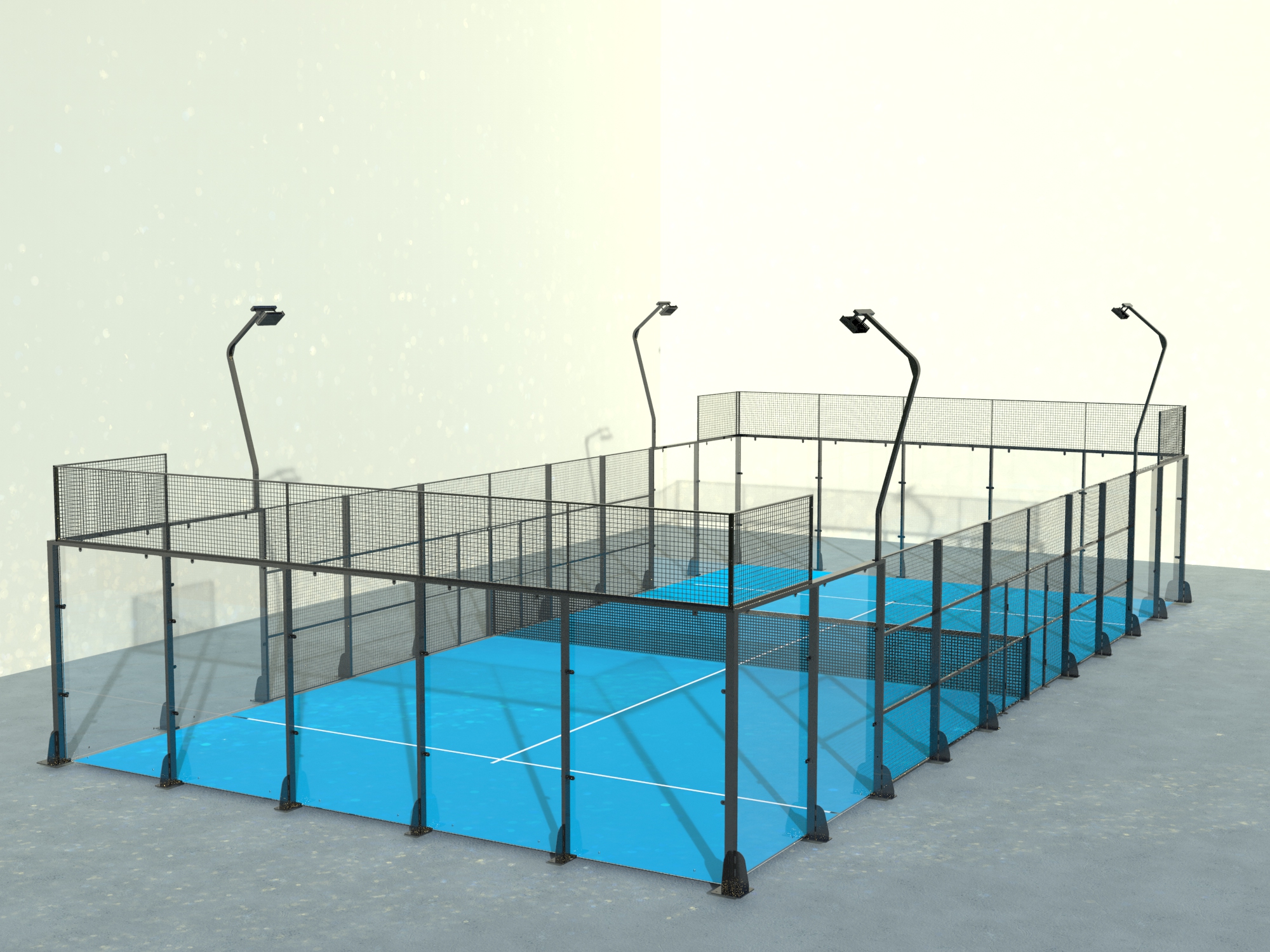
The LDK-PD01 is an open padel court built on a 20m × 10m playing area with a perimeter enclosure rather than a roof. Its verified configuration is:
- Enclosure glass: 12mm-thick, 1990×2980mm ultra-clear tempered safety glass, certified with an extremely low spontaneous breakage rate of 1 in 10,000.
- Corner posts: 4m-high 100×100×5mm steel tube.
- Intermediate and gate posts: 100×50×3mm steel tube.
- Horizontal tubing: 100×50×3mm in 4m, 6m and 4m lengths.
- Wire mesh panels: 1×2m steel wire mesh, 4.0mm wire diameter, 50×50mm openings.
- Net system: 940mm-high net posts (120×60×3mm) with a 10m-long, 92cm-high black PP (polypropylene) net, 4mm cord diameter, 45×45mm mesh openings.
- Lighting: 100×50×3mm light posts fitted with 200W LED fixtures rated IP65 for ingress protection.
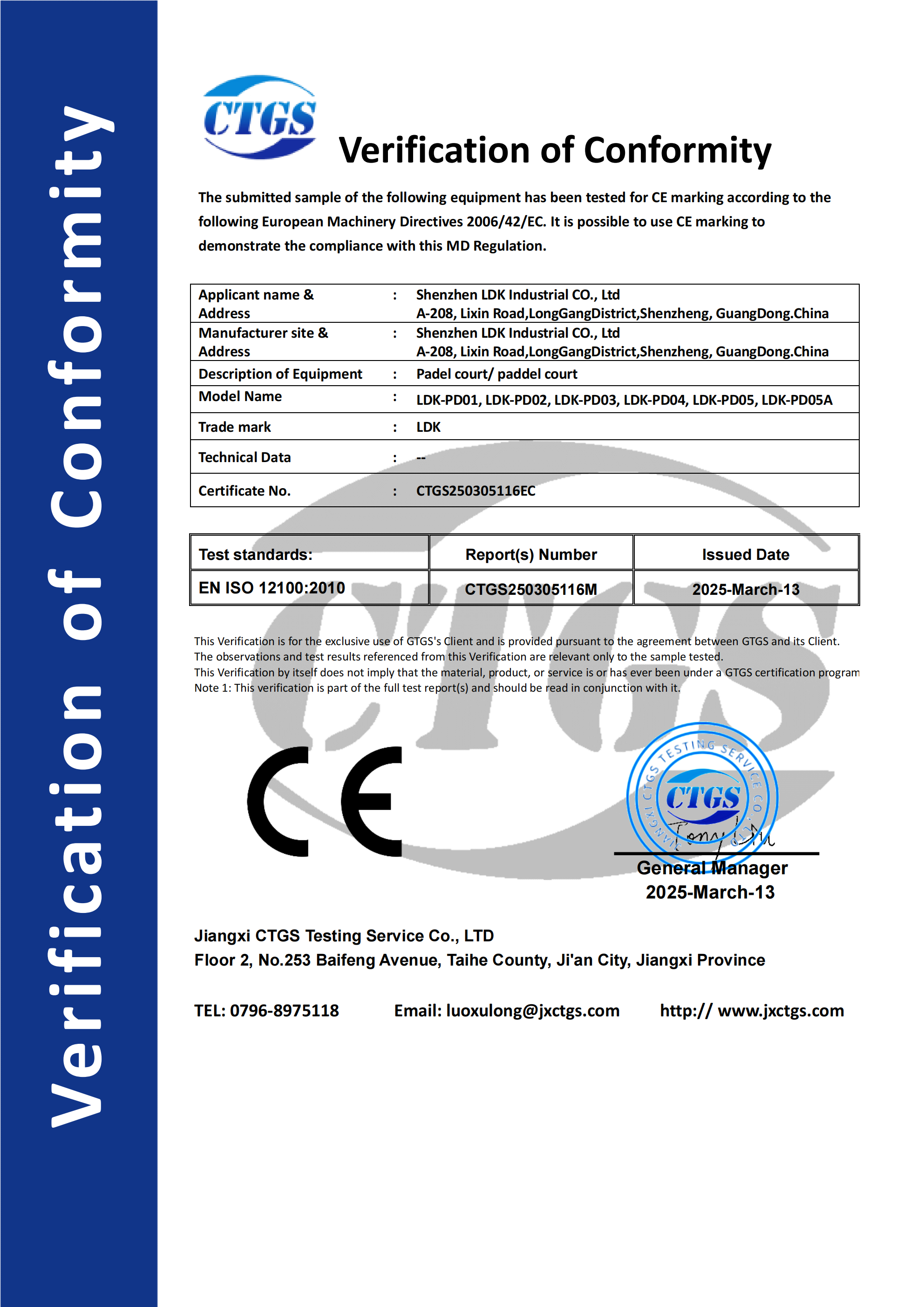
Compliance documentation exists for this platform in two markets. A Verification of Conformity to EN ISO 12100:2010 (certificate CTGS250305116EC, issued by Jiangxi CTGS Testing Service Co., LTD) covers the EU market. A glass test report to AS 2208:2023+A1:2024 (report GZIN2602000283CM01_EN, issued by SGS-CSTC Standards Technical Services Co. Ltd. Guangzhou Branch) covers the Australia / New Zealand market.
What this means for a buyer: the LDK-PD01 is structurally simple. There is no fabric to replace, no roof drainage to maintain, and no additional vertical load on the foundation. The trade-off is that play stops when the weather stops cooperating, and the 4m enclosure height means lighting and structure sit at enclosure level rather than above the playing envelope.
Option B — The Panoramic Padel Court With Roof (LDK-PADEL-RF01)
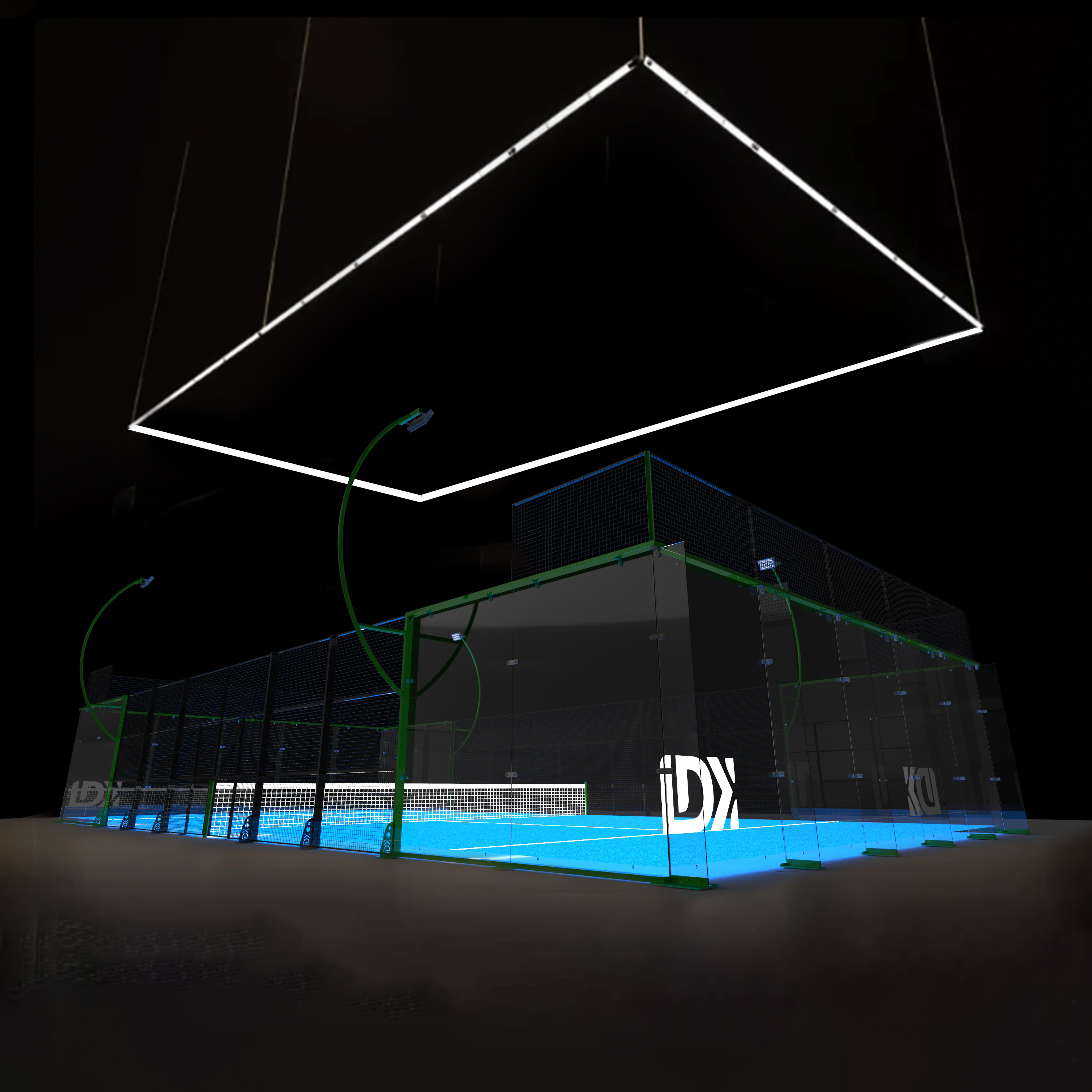
The LDK-PADEL-RF01 keeps the same 20m × 10m playing area and adds a hot-dip galvanized steel canopy over it. Its verified configuration is:
- Court size: 20m (L) × 10m (W); eaves height 7m, ridge height 9.2m.
- Corner columns: 150×200×4mm hot-galvanized steel tube, 8 pieces.
- Middle columns: 100×50×3mm steel tube, 12 pieces.
- Beams: Φ102 / Φ89 / Φ40 × 3mm hot-galvanized steel tube; cross tubes 100×50×3mm (4m / 6m, 16 pieces); high-strength bolt connections.
- Surface treatment: hot-dip galvanizing plus electrostatic epoxy powder coating, 70–80μm thick.
- Wind resistance: Level 10–13 typhoon rated.
- Roof fabric: 750g/m² double PVC-coated PVDF material with a 10–15 year service life.
- Enclosure: 12mm-thick, 1990×2980mm safety tempered glass (18 pieces) and 1×2m wire mesh, 4mm wire, 50×50mm holes (46 pieces).
- Net system: 980mm-high post set with a 10m × 970mm knotted PP net, 4mm rope, 50×50mm mesh.
- Lighting: 200W LED (IP65) mounted on 100×50×3mm columns.
- Hardware: stainless steel electro-polished bolts, nuts and washers.
- Artificial grass: blue, 12mm pile height, 63,000 tufts/m², 9000D yarn, PP+NET backing.
LDK also supplies padel artificial grass as a standalone material — model LDK1231625.4-ST3, with 12mm pile height, 9000 Dtex yarn, 3/16\" gauge, double PP + PU latex backing, a density of 58,800 stitches/m² (±10%), and colour options covering blue, red, green, pink and black.
What this means for a buyer: the roofed court is a structure, not a court with an accessory. The 7m eaves and 9.2m ridge create the vertical envelope FIP recommends for competitive play (9–12m), and the Level 10–13 typhoon rating addresses the wind loads that dominate coastal and cyclone-exposed sites. In exchange, the project carries a column grid, a foundation design matched to 150×200×4mm corner columns, and a roof fabric that will be replaced once within its 10–15 year service life.
Step-by-Step: Five Tests Before You Choose a Court Type
Step 1 — Score the site on weather exposure
List annual rain days, peak summer temperatures, and the local wind classification. If the site faces typhoon-level wind loads, the LDK-PADEL-RF01's Level 10–13 wind resistance is the relevant benchmark; the standard LDK-PD01 product data does not state an equivalent wind rating, so open courts in those zones should be assessed against the site's own structural requirements. For mild inland climates with limited rain disruption, the open court is the lower-complexity choice.
Step 2 — Check the vertical envelope and site constraints
FIP sets a minimum indoor ceiling height of 6m and recommends 9–12m for professional play. The roofed court occupies the upper end of that envelope: 7m at the eaves and 9.2m at the ridge. Before selecting the panoramic option, confirm local height limits, distance to neighbouring structures, cranage access for the 8 corner columns, and slab capacity for a roofed structure. If the project is inside an existing hall that already provides clearance, the roofed court adds cost without adding usable hours.
Step 3 — Model usage intensity, not just capacity
Compare the number of hours you can realistically sell in each configuration. A roofed panoramic padel court keeps evening and wet-weather slots open, which matters most for commercial clubs with fixed staffing and membership commitments. Both LDK systems use 200W LED fixtures rated IP65, so night play is achievable either way; the difference is whether the roof keeps the court dry and shaded during the day.
Step 4 — Build the life-cycle cost picture
Compare the two systems across five cost lines: enclosure glass (12mm tempered with a 1 in 10,000 spontaneous breakage rate on the LDK-PD01), roof fabric (750g/m² double PVC-coated PVDF, 10–15 year service life on the LDK-PADEL-RF01), steel protection (hot-dip galvanizing plus 70–80μm epoxy powder coating), surface and net wear, and the labour cost of inspection. LDK backs both courts with a 1–5 year warranty. The roofed court adds a scheduled fabric replacement event; the open court adds weather-related downtime events.
Step 5 — Verify documentation before deposit
Request the compliance pack that matches your destination market. For the LDK-PD01 platform, LDK holds a CE Verification of Conformity to EN ISO 12100:2010 for the EU market and a glass test report to AS 2208:2023+A1:2024 issued by SGS-CSTC for the Australia / New Zealand market. For any roofed structure, ask for wind-resistance documentation that matches your site classification, and confirm that the glass and hardware specification in your order matches the documents you were shown.
Use Cases: Matching Court Type to Project Profiles
Coastal or typhoon-exposed outdoor clubs. Where wind classification is the governing load, the LDK-PADEL-RF01's Level 10–13 typhoon wind resistance and hot-dip galvanized frame address the failure mode that matters most. The roof also removes salt-and-rain-driven surface wear from the daily maintenance list.
Mild-climate inland clubs and covered halls. Where rain disruption is limited and a structure already exists overhead, the LDK-PD01 delivers the same 12mm tempered glass enclosure, 200W IP65 LED lighting and net system without the roof structure cost.
High-intensity commercial venues. The LDK-PADEL-RF01's blue 12mm padel grass at 63,000 tufts/m² with 9000D yarn is specified for frequent play, and the 10–15 year PVDF roof fabric spreads the roof cost across a long operating period. This is the configuration for venues selling prime-time and evening slots year-round.
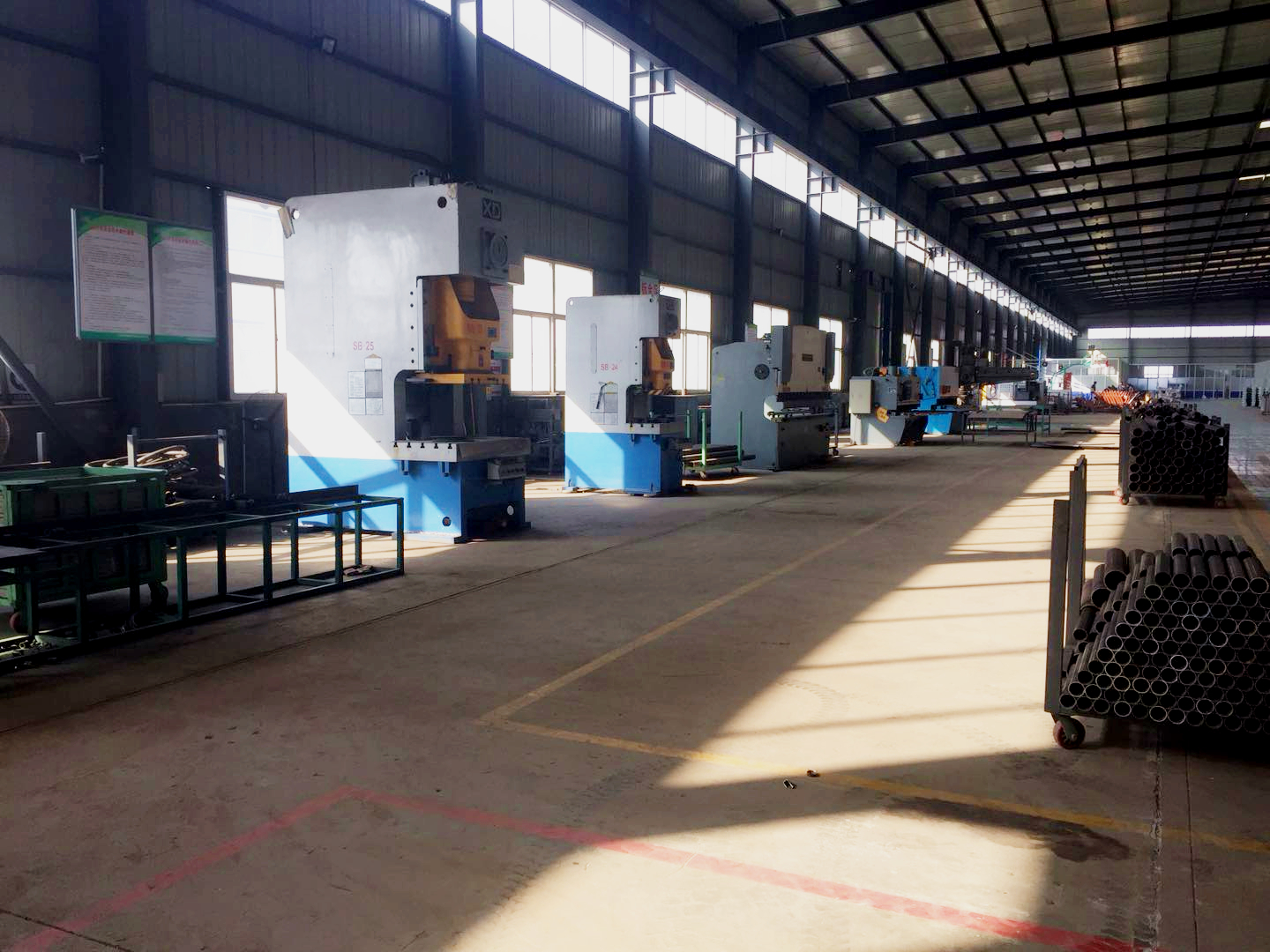
Multi-sport facility campuses. LDK manufactures padel courts alongside football pitches, squash courts, basketball courts and pickleball courts, which allows a single supplier and one logistics plan across a mixed facility — relevant when padel is added as an anchor activity beside a soccer cage or soccer pitch.
Phased rollouts. LDK's MOQ is 1 unit, with a monthly capacity of 200 units and a production lead time of 30–45 days. Facilities that want to validate a location before scaling can start with a single court.
Field evidence. An automotive OEM client in Chile operates 16 LDK padel courts in a padel club and reports three years of stable operation, noting that the venue is extremely durable, requires almost no maintenance and can be used throughout the year. A second automotive ODM client in Bangladesh operates 70 LDK padel court units with three years of stable operation, and cites International FIP plus CE certification as the basis for its quality and safety expectations.
Standard vs. Panoramic With Roof: Side-by-Side Comparison
| Decision dimension | LDK-PD01 — Standard Padel Court | LDK-PADEL-RF01 — Panoramic Court With Roof |
|---|---|---|
| Playing area | 20m × 10m | 20m × 10m |
| Enclosure glass | 12mm tempered, 1990×2980mm; spontaneous breakage rate 1 in 10,000 | 12mm tempered safety glass, 1990×2980mm, 18 pieces |
| Wire mesh | 1×2m panels, 4.0mm wire, 50×50mm openings | 1×2m panels, 4mm wire, 50×50mm openings, 46 pieces |
| Corner posts | 4m high, 100×100×5mm | 150×200×4mm hot-galvanized steel tube, 8 pieces |
| Intermediate / middle posts | 100×50×3mm intermediate and gate posts | 100×50×3mm steel tube, 12 pieces |
| Roof | None — open-air court | 750g/m² double PVC-coated PVDF fabric, 10–15 year service life |
| Height envelope | Open; light posts 100×50×3mm | Eaves 7m, ridge 9.2m |
| Wind resistance | Not stated in the product specification | Level 10–13 typhoon |
| Surface treatment | Not stated in the product specification | Hot-dip galvanizing + electrostatic epoxy powder coating, 70–80μm |
| Lighting | 200W LED, IP65, on 100×50×3mm light posts | 200W LED, IP65, on 100×50×3mm columns |
| Net system | 940mm net posts (120×60×3mm); 10m × 92cm black PP net | 980mm post set; 10m × 970mm knotted PP net |
| Hardware | Steel with wire mesh and PP net | Stainless steel electro-polished bolts, nuts, washers |
| Compliance documents held | CE Verification of Conformity, EN ISO 12100:2010 (EU); glass test report AS 2208:2023+A1:2024, SGS-CSTC (AU/NZ) | Confirm the certification pack for the ordered configuration and destination market |
| Best-fit climate | Mild, low-wind, or indoor hall with existing roof | Rainy, high-heat, coastal or typhoon-exposed sites |
| Primary maintenance focus | Glass, net, playing surface, lighting | Roof fabric, galvanized steel coating, glass, net, surface |
Frequently Asked Questions
Does a panoramic padel court with roof still meet official court dimensions and safety requirements?
Yes. The International Padel Federation defines the playing area as 20m × 10m with a 0.5% tolerance, and the LDK-PADEL-RF01 is built to that 20m × 10m footprint. Its enclosure uses 12mm-thick, 1990×2980mm tempered safety glass across 18 panels, which aligns with the shift across the industry from 10mm to 12mm tempered glass for premium panoramic courts. On vertical clearance, FIP requires a minimum indoor ceiling of 6m and recommends 9–12m for professional play; the RF01 provides 7m at the eaves and 9.2m at the ridge. Buyers should confirm that the certification pack for their specific order configuration and destination market is included, since documentation is issued per product and per market.
Can one manufacturer supply both the standard court and the roofed panoramic court, including customization?
SHENZHEN LDK INDUSTRIAL CO., LTD. operates an OEM/ODM production model and manufactures both configurations in-house: the LDK-PD01 standard padel court and the LDK-PADEL-RF01 panoramic padel court with roof. Customization covers court size, colour, logo printing, surface material, fencing design and lighting configuration. LDK runs a 50,000 m² manufacturing base in Cangzhou and a 4,500 m² R&D and production base in Huizhou, employs 17 R&D engineers, applies 100% testing in quality control, and reports a monthly capacity of 200 units. Its wider sports equipment portfolio also includes football pitches, squash courts, basketball courts and pickleball courts.
What drives the long-term cost difference between the two court types?
The cost difference is structural rather than cosmetic. The roofed LDK-PADEL-RF01 adds a hot-dip galvanized steel frame with 150×200×4mm corner columns, an 8-point column grid, and a 750g/m² double PVC-coated PVDF roof fabric with a stated 10–15 year service life — so it introduces a scheduled roof replacement event, but its 70–80μm galvanized and powder-coated finish protects the steel over the long term. The open LDK-PD01 avoids roof structure and fabric entirely, and its 12mm tempered glass is specified with a spontaneous breakage rate of 1 in 10,000, which reduces glass replacement risk. Both systems use 200W IP65 LED lighting and are covered by a 1–5 year warranty. The practical trade-off is fabric replacement cost versus weather-related downtime.
Can we validate materials and documentation before committing to a full order?
Yes. LDK's minimum order quantity is 1 unit, which allows a single-court trial installation before scaling a multi-court project. At the evaluation stage, buyers can review the compliance documents that already exist for the LDK-PD01 platform — the CE Verification of Conformity to EN ISO 12100:2010 for the EU market and the AS 2208:2023+A1:2024 glass test report issued by SGS-CSTC for Australia / New Zealand — and confirm the equivalent documentation for the roofed configuration and the relevant destination market.
What is the lead time, and how do we start a project?
LDK quotes a production lead time of 30–45 days with a monthly capacity of 200 units, and states that new product development can be completed in as few as 10 days. The fastest way to move from evaluation to a firm decision is to request a configuration-specific quotation and a sample or single-unit trial, using the court type, destination country and site wind classification you identified in the five tests above. You can download the LDK product brochure here: LDK product brochure, and reach the export team directly at anna@ldkchina.com or via WhatsApp on +86 15219504797.
Conclusion: A Simple Decision Rule
Choose the standard padel court (LDK-PD01) when the site is mild and low-wind, when a roof structure already exists overhead, when height or foundation capacity is constrained, and when capital efficiency matters more than all-weather availability. Choose the panoramic padel court with roof (LDK-PADEL-RF01) when rain or heat would otherwise remove bookable hours, when the site faces typhoon-level wind loads that a Level 10–13 rated frame is designed for, and when the project can absorb a 7m–9.2m structural envelope in exchange for year-round play.
Both paths lead to the same 20m × 10m court with 12mm tempered glass and 200W IP65 LED lighting. The deciding factors are climate, site envelope and usage intensity — and the documentation and lead time that determine how quickly the venue starts earning.
Next step
Send us your site location, wind classification and target number of courts, and the LDK team will recommend the configuration that fits. Request a quotation, sample or a single-unit trial court from SHENZHEN LDK INDUSTRIAL CO., LTD. — email anna@ldkchina.com, WhatsApp +86 15219504797, or visit www.ldkchina.com. The full product brochure is available for download here: LDK product brochure.
Have Questions or Need More Details?
Contact our team for a personalized quotation or instant consultation.
Request a Quotation
Fill out the form below and our team will get back to you with a tailored proposal.
WhatsApp Direct Chat
Prefer to chat in real-time? Message us on WhatsApp for instant assistance & quick answers.
- Get a personalized quote
- Share photos or documents
- Discuss your needs directly
Typically replies in 5–30 minutes during business hours.