
How to Match Padel Court Projects With the Right Court Type: A Facility Planning Guide
How to Match Padel Court Projects With the Right Court Type: A Facility Planning Guide
When a sports facility project involves a padel court, the first practical question is not “which brand” but “which court type fits the site, the weather, the budget, and the expected usage.” The answer depends on a small set of project variables: outdoor or indoor, open-air or roofed, performance level, operating hours, and the local climate.
This guide is written for sports facility developers, club operators, procurement teams, and investors moving from research to evaluation. It explains how to match a padel court project with a suitable court configuration, what to look for in a court manufacturer, and how to translate site requirements into a practical specification.
Why the Right Court Type Is a Project Decision
Padel is played on a court that measures 20m long by 10m wide, with a 0.5% tolerance under International Padel Federation (FIP) rules. That dimension is fixed, but the court system around it is not. A standard open court, a panoramic court with glass walls, and a roofed panoramic court serve different operating models.
For an outdoor club in a region with heavy rain, strong sun, or wind, a roofed court extends usable hours and protects players. For a multipurpose indoor complex, an open panoramic court can be integrated into a hall with an existing ceiling. For a budget-conscious operator with limited space, a standard mesh-enclosed court may be sufficient. The court type should follow the project context, not the other way around.
Industry Context: Demand Growth and Facility Decisions
Padel infrastructure is expanding quickly. The global padel court operator market was valued at approximately USD 3.8 billion in 2025 and is projected to reach USD 9.6 billion by 2034. As of early 2025, the global total of padel courts reached approximately 58,334 across nearly 20,000 clubs, a 16% year-over-year increase. The U.S. market is projected to grow from about 650 courts in early 2025 to 30,000 courts and over 10 million players by 2030.
These figures help explain why facility planners are under pressure to choose scalable, durable court systems. A court must not only meet the rules of the game but also support continuous commercial use, easy maintenance, and long-term expansion.
Project Types and Court Matching Logic
Different projects impose different constraints. The table below sets out a practical matching approach.
| Project Type | Typical Conditions | Recommended Court Direction | Main Rationale |
|---|---|---|---|
| Commercial padel club (outdoor) | High traffic, all-weather exposure, 24/7 operation | Panoramic court with tempered glass; roofed version where climate demands | Durability, visibility, extended playing hours |
| Multi-sport sports complex | Shared space, existing building or podium | Standard panoramic court or classic court depending on ceiling height | Flexible integration, controlled installation complexity |
| Hotel / resort facility | Moderate usage, aesthetics matter | Panoramic glass court with color options | Visual appeal, guest experience |
| Community or school facility | Budget-sensitive, high turnover | Classic court with mesh enclosure | Lower cost, robust structure |
| Indoor arena | Existing hall, 6m minimum ceiling height required | Open panoramic court without dedicated roof | Compliance with FIP indoor height guidance |
For projects in Australia, New Zealand, and the United States, a common application scenario is an outdoor sports facility operating under high-traffic, all-weather conditions, available 24/7. In this scenario, the court functions as a venue for sports training and competition, with special requirements including compliance with FIP standards, CE certification (EN ISO 12100), and AS 2208 (SGS) certified safety glass.
Standard vs Panoramic vs Roofed: What Changes
Decision-makers often ask what they are actually paying for when they move from a standard court to a panoramic court or a roofed court. The main differences are in the enclosure, the glass, the steel structure, and the roof membrane.
Standard (Classic) Padel Court
A classic padel court typically combines glass panels around the bottom of the perimeter with steel wire mesh above. The playing area remains the same, but visibility for spectators and the premium feel are limited compared with a full panoramic design. This is often the most cost-effective option for community and school projects.
Panoramic Padel Court
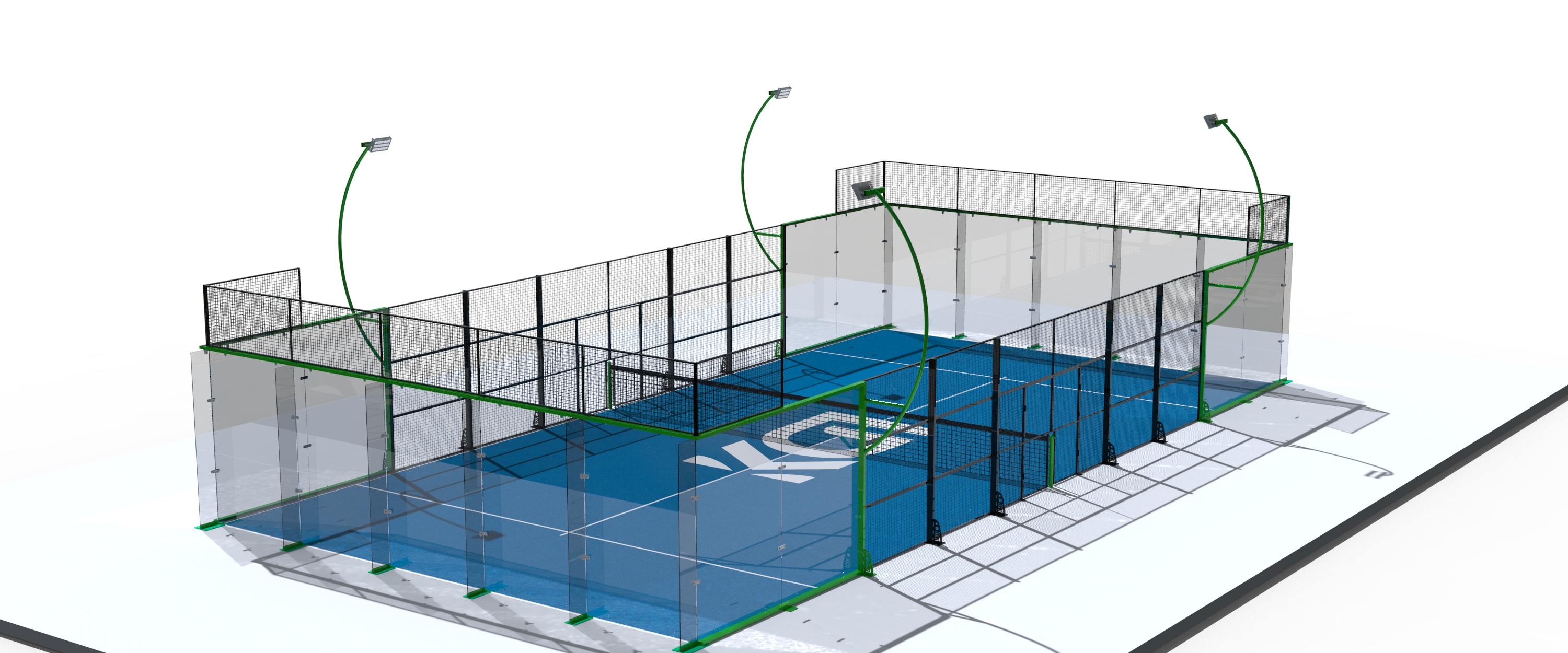
A panoramic padel court uses tempered safety glass around the perimeter to create a clearer, more open appearance. For example, the LDK-PD01 padel court from Shenzhen LDK Industrial Co., Ltd. uses 12mm-thick, 1990×2980mm ultra-clear tempered safety glass with a very low spontaneous breakage rate of 1 in 10,000. The enclosure system includes 4m-high 100×100×5mm corner posts, 100×50×3mm intermediate and gate posts, and 100×50×3mm horizontal tubing, complemented by 1×2m steel wire mesh panels with 4.0mm wire diameter and 50×50mm mesh openings.
The 12mm glass standard represents a shift from the previous 10mm standard for premium panoramic padel courts, delivering enhanced safety and more consistent ball rebound.
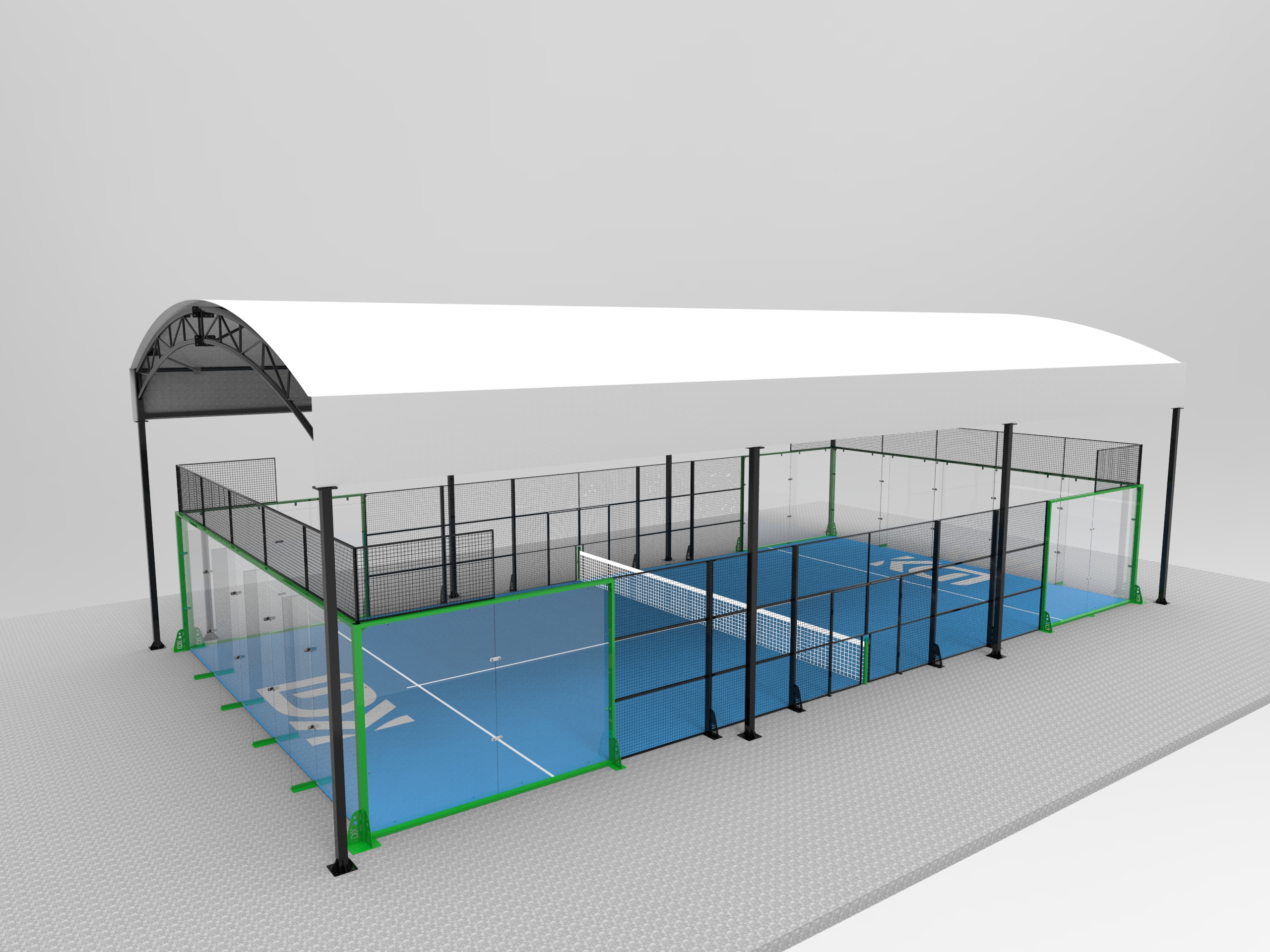
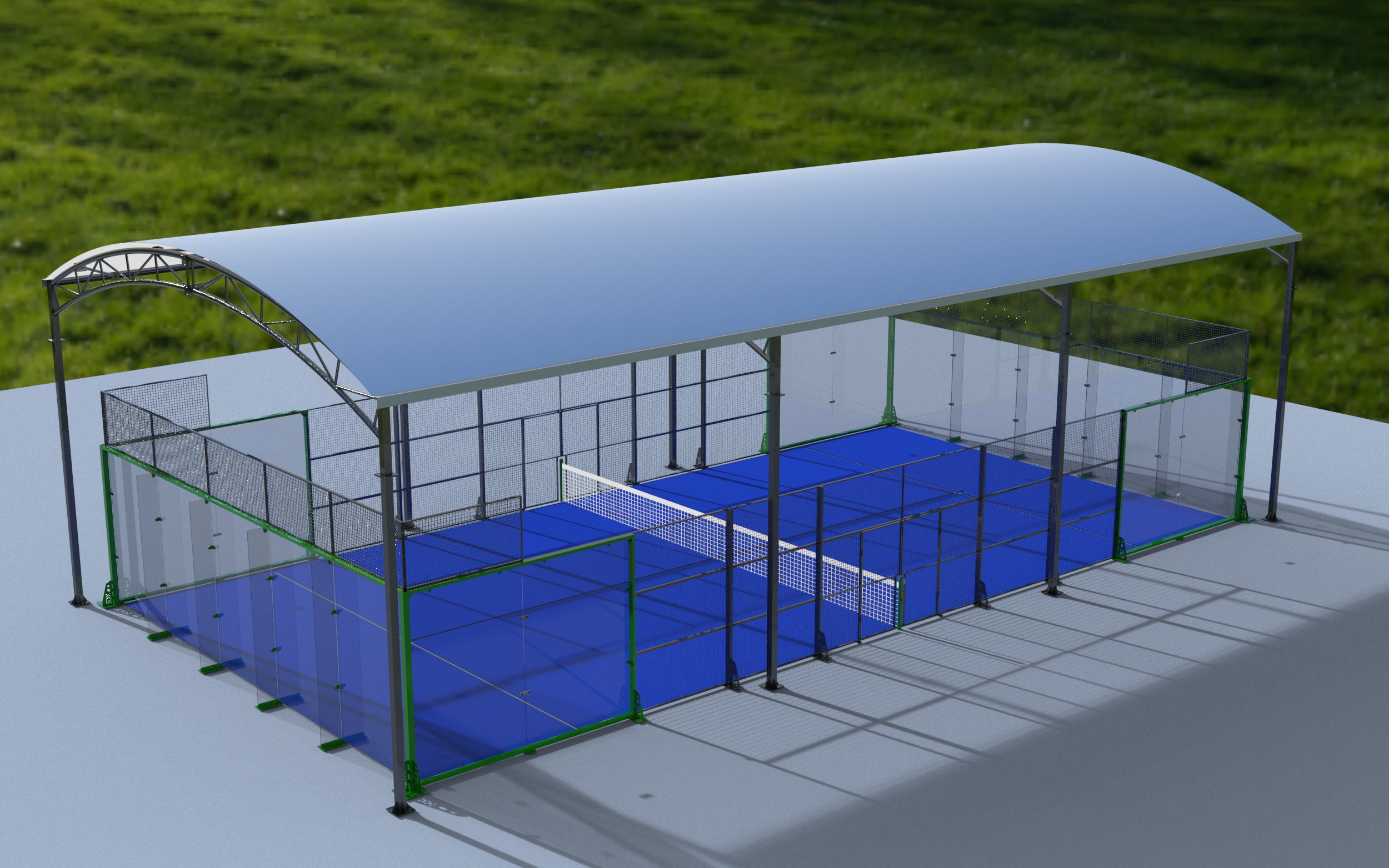
Panoramic Padel Court With Roof
A roofed panoramic court adds a steel structure and tensile membrane roof. LDK’s LDK-PADEL-RF01, for example, measures 20m × 10m with a 7m eaves height and a 9.2m ridge height. The steel structure uses 150×200×4mm hot-galvanized steel corner columns, 100×50×3mm middle columns, and Φ102/Φ89/Φ40×3mm beams. The roof is 750g/m² double PVC-coated PVDF fabric with a service life of 10 to 15 years. The system is designed to withstand wind loads corresponding to level 10 to 13 typhoons.
A roofed court is especially valuable for high-traffic outdoor venues because it reduces weather-related downtime and protects the artificial grass from excessive direct sun and rain.
Court Components That Must Match the Project
Beyond the court type, the component specification determines how well the court performs under real operating conditions. The following elements should be checked against the project brief.
Enclosure: Glass and Wire Mesh
The enclosure affects safety, playability, spectator experience, and maintenance. For a premium facility, 12mm tempered safety glass is recommended. In LDK’s roofed court, the glass specification is 12mm thick, 1990×2980mm, with 18 panels, combined with 46 wire mesh panels measuring 1×2m, using 4mm wire and 50×50mm openings. This combination gives a clear viewing experience while preserving the required ball rebound characteristics.
Steel Structure and Surface Treatment
Outdoor courts must resist corrosion. Hot-dip galvanizing followed by electrostatic epoxy powder coating at 70 to 80 microns thickness is a robust finishing approach used on LDK’s roofed court structure. For coastal or industrial environments, this level of protection matters more than for indoor installations.
Artificial Grass
Padel-specific artificial grass is not a generic turf product. LDK’s Padel Grass, model LDK1231625.4-ST3, has a 12mm pile height, 9000 Dtex yarn, a 3/16-inch gauge, double PP + PU latex backing, and a density of 58,800 stitches per square meter (±10%). It is available in blue, red, green, pink, and black to match club branding. The roofed court version uses blue grass with a density of 63,000 tufts/m² and a PP+NET backing.
Lighting
For evening and 24/7 operation, lighting must be positioned and protected correctly. LDK’s system uses 200W LED fixtures rated IP65, mounted on 100×50×3mm light posts. The IP65 rating is important for outdoor exposure to rain and dust.
Net and Posts
The net system must meet FIP dimensions. In the LDK-PD01 court, the net posts are 940mm high, made of 120×60×3mm tubing, and the net is 10m long and 92cm high with a 4mm cord diameter and 45×45mm mesh. In the roofed court model, the tennis post set is 980mm high with a 10m × 970mm knotted PP net using a 4mm rope and 50×50mm mesh.
Step-by-Step: From Project Brief to Court Specification
Facility owners and procurement teams can use the following workflow to evaluate a padel court project systematically.
- Define the operating model. Decide whether the court will run as a paid club, a hotel amenity, a community facility, or a training venue. This determines the expected hours, traffic, and revenue target.
- Assess the site. Measure the available footprint, check the ground conditions, and identify whether the court will be outdoor, under an existing roof, or in a new building. Confirm that ceiling height meets at least 6m for indoor play.
- Evaluate climate and weather risk. For outdoor sites with heavy rain, snow, or strong sun, consider a roofed panoramic court. For sheltered or indoor sites, a standard or panoramic open court may be sufficient.
- Set the safety and compliance baseline. Confirm which standards apply in the destination market. For high-traffic projects, require FIP-compliant dimensions, CE certification per EN ISO 12100, and AS 2208 (SGS) certified safety glass where relevant.
- Match the court configuration. Select the enclosure type, glass specification, roof option, artificial grass, lighting, and net system based on the project type and budget.
- Check manufacturer capability. Verify that the supplier can produce at the required quality level, customize where needed, and deliver at the project schedule.
- Plan maintenance and warranty. Confirm the grass, structure, glass, and accessories are replaceable and that the manufacturer provides clear after-sales support.
Use Case 1: High-Traffic Outdoor Club in Australia or New Zealand
A typical project in the Australia, New Zealand, and United States region is an outdoor sports facility operating under high traffic and all-weather conditions, available 24/7. The court is used for sports training and competition.
For this use case, the recommended configuration is a panoramic court with 12mm tempered safety glass, FIP-compliant dimensions, and a roof if the local climate creates rain or heat constraints. The artificial grass should be padel-specific, with 12mm pile height and adequate UV resistance. The lighting should be IP65-rated for outdoor operation. The project should specify FIP compliance, CE certification (EN ISO 12100), and AS 2208 (SGS) certified safety glass where the local building code requires it.
- Why it works: Glass panels provide better visibility for spectators, the steel structure supports continuous daily use, and the roof preserves playability in wet weather.
- Potential trade-off: A roofed panoramic court has a higher initial investment than a standard open court. The decision depends on expected utilization and revenue.
Use Case 2: Scalable Club Project in Bangladesh
One documented project involved an automotive ODM client in Bangladesh that installed 70 units of padel courts. The courts remained stable over a three-year period. The client highlighted that international FIP and CE certification ensured quality and safety.
This case illustrates a different decision logic. When an operator plans a large number of courts, certification consistency and repeatability become critical. The buyer benefits from a manufacturer that can supply a large volume of courts with uniform quality, standardized components, and consistent installation support.
- Why it works: Large-scale projects require standardized specifications, certification traceability, and stable supply capacity.
- Potential trade-off: A multi-unit project demands rigorous quality control and a supplier with sufficient manufacturing capacity and team strength.
Use Case 3: Low-Maintenance Club in Chile
An automotive OEM client in Chile used 16 units of padel courts for a padel court club. After three years, the venue remained stable and required almost no maintenance, remaining usable throughout the year. The highlight of the project was exceptional durability and low maintenance costs.
For this type of project, the court components and surface treatment must be selected for long service life. Hot-dip galvanized steel with powder coating, tempered safety glass, and padel-specific artificial grass combine to reduce maintenance frequency under continuous outdoor use.
- Why it works: Durable materials and finishing reduce downtime and maintenance cost, raising net revenue over the court’s life.
- Potential trade-off: Higher-grade materials may carry a higher upfront price, so the buyer should compare life-cycle cost rather than initial price alone.
Comparison Table: Standard vs Panoramic vs Roofed Padel Court
The table below compares the main court configurations at the system level.
| Feature | Standard / Classic Court | Panoramic Court (LDK-PD01) | Roofed Panoramic Court (LDK-PADEL-RF01) |
|---|---|---|---|
| Playing dimensions | 20m × 10m | 20m × 10m | 20m × 10m |
| Structure height | Depends on enclosure | 4m posts | Eaves 7m, ridge 9.2m |
| Glass | Partial or mixed | 12mm tempered safety glass, 1990×2980mm | 12mm tempered safety glass, 1990×2980mm (18pcs) |
| Wire mesh | Steel wire mesh | 1×2m, 4mm wire, 50×50mm | 1×2m, 4mm wire, 50×50mm (46pcs) |
| Roof system | Not included | Not included | 750g/m² double PVC-coated PVDF; 10-15 years service life |
| Wind resistance | Standard outdoor rating | Standard outdoor rating | Level 10~13 typhoon design |
| Artificial grass | Optional | Padel grass, 12mm pile | Blue grass, 12mm pile, 63,000 tufts/m² |
| Lighting | Optional | 200W LED IP65 | 200W LED IP65 |
| Typical best fit | Schools, community courts | Clubs, multi-sport complexes | Premium outdoor clubs, weather-exposed venues |
Manufacturer Capabilities to Check During Evaluation
When you move from court type selection to supplier evaluation, the following manufacturer facts help distinguish a project partner from a product reseller.
Production and Quality Control
Shenzhen LDK Industrial Co., Ltd. is an integrated sports equipment manufacturer engaged in R&D, production, and sales. It operates a 4,500 square meter R&D and production base in Huizhou and a 50,000 square meter manufacturing base in Cangzhou. The company has 107 employees and 17 R&D engineers. It reports a monthly capacity of 200 padel court units, a lead time of 30 to 45 days, a minimum order quantity of one unit, and 100% testing as part of its quality control.
Customization and OEM/ODM
For facility projects, customization is not a luxury; it is a functional requirement. LDK supports OEM/ODM production with customization options including court size, color, logo printing, surface material, fencing design, and lighting configuration. New product development can be completed in as few as 10 days, which is useful when a project needs a tailored court solution.
Certifications and Compliance
LDK holds ISO 9001, ISO 45001, ISO 14001, and CE certifications. The company exports 100% of its production and serves markets worldwide with a particularly strong presence in North America, South America, Europe, and Southeast Asia. It is also a verified Alibaba.com Gold Supplier. For projects in Australia, New Zealand, and the United States, the relevant product-level certifications include CE (EN ISO 12100) and AS 2208 (SGS) certified safety glass.
Experience and After-Sales
LDK has over 11 years of export experience. Its customer base spans brands, contractors, and end users, with documented multi-unit projects in Chile (16 units) and Bangladesh (70 units). The company provides a warranty of 1 to 5 years depending on the product and project agreement.
Cost, ROI, and Long-Term Value
Although specific project pricing depends on configuration, location, and scope, the investment logic follows a predictable pattern. A panoramic padel court investment typically yields an ROI within 12 to 18 months in high-demand urban areas due to 70 to 90% peak occupancy rates, according to third-party analysis. Open-air standard courts are usually more affordable to procure but may generate less revenue in weather-constrained seasons. Roofed panoramic courts are a larger initial investment but can operate more consistently through the year.
The practical comparison for a project is not only purchase price. The procurement team should compare life-cycle cost, which includes installation, artificial grass replacement, glass replacement risk, steel structure maintenance, lighting energy use, and the expected utilization rate of the court.
Common Pitfalls in Padel Court Project Matching
Avoiding a mismatch is easier than correcting it after installation.
- Choosing an open court for a rainy climate: The court will sit idle, lowering revenue and increasing moss or grass maintenance.
- Installing a standard court where a panoramic court is expected: Spectator experience and brand positioning may suffer in commercial clubs.
- Ignoring glass certification: Safety glass that does not meet local standards can create liability and delay facility approval.
- Over-specifying a roof for a covered indoor hall: A client may pay for wind-rated roofing that is not needed inside a building.
- Choosing generic turf instead of padel-specific grass: Ball bounce and player grip differ significantly between turf types.
FAQ
Does a padel court project need to comply with FIP standards?
Yes, in most professional and commercial settings. Official padel court dimensions are strictly 20m x 10m with a 0.5% tolerance, and the minimum indoor ceiling height is 6m, with 9-12m recommended for professional play. FIP compliance is also a common requirement in high-traffic sports facility projects. Courts that meet FIP dimensions can be used for official training and competition, which supports club operations and player trust.
What certifications should a roofed padel court have for an outdoor project?
The project should clearly require FIP-compliant dimensions plus product-level safety certifications. In the Australia, New Zealand, and United States markets, relevant requirements include CE certification according to EN ISO 12100 and AS 2208 (SGS) certified safety glass. A manufacturer such as LDK also holds ISO 9001, ISO 45001, ISO 14001, and CE certifications for its sports equipment production.
Can a padel court be customized to fit a specific site or brand?
Yes. Padel court manufacturers such as LDK support OEM/ODM production with customization options for court size, color, logo printing, surface material, fencing design, and lighting configuration. Artificial grass color can also be matched to a club’s brand; LDK’s Padel Grass is available in blue, red, green, pink, and black. New product development can be completed in as few as 10 days, making custom design feasible for projects.
What does a panoramic padel court cost compared with a standard court?
Specific costs depend on configuration, steel structure, glass area, roof system, artificial grass, lighting, shipping, and installation. A panoramic court costs more than a standard mesh-enclosed court because it uses larger tempered glass panels and a more extensive steel enclosure. A roofed panoramic court adds the roof membrane and additional structural steel. Because project pricing is highly variable, it is advisable to request a quotation with a clear bill of materials and compare life-cycle cost rather than comparing only the initial price.
How long does it take to manufacture and deliver a padel court for a sports facility project?
Many manufacturers quote a production lead time of 30 to 45 days for padel courts, with a minimum order of one unit. Delivery time depends on the destination, port congestion, and whether the court is a standard or custom design. For complex multi-unit projects, procurement teams should also allow time for certification documentation and factory inspection. For example, LDK reports a monthly padel court manufacturing capacity of 200 units and a standard lead time of 30 to 45 days.
Can I request a sample or detailed quotation for a padel court project?
Yes. For a project-specific estimate, you can contact LDK directly with your site conditions, court type, quantity, and destination. The company provides OEM/ODM support, and samples or detailed technical documentation can be arranged. To start the conversation, download the company brochure or contact the team at Anna \u2013 email anna@ldkchina.com, Tel/WhatsApp 15219504797.
Conclusion
Matching a padel court project with the right court type is a structured decision. Start with the operating model and site conditions, then select the enclosure, roof, glass, grass, lighting, and net system that fit the project. Use FIP dimensions and relevant safety certifications as the baseline, and compare life-cycle cost rather than initial price alone.
For sports facility developers and operators, the practical next step is to prepare a short project brief and request a technical quotation from manufacturers that can provide certified materials, OEM/ODM flexibility, and documented delivery performance.
LDK Sports Facility Solutions
Padel courts, panoramic roofed courts, padel grass, and multi-sport court systems with OEM/ODM support.
Download the LDK company brochure or contact anna@ldkchina.com / WhatsApp 15219504797.
Have Questions or Need More Details?
Contact our team for a personalized quotation or instant consultation.
Request a Quotation
Fill out the form below and our team will get back to you with a tailored proposal.
WhatsApp Direct Chat
Prefer to chat in real-time? Message us on WhatsApp for instant assistance & quick answers.
- Get a personalized quote
- Share photos or documents
- Discuss your needs directly
Typically replies in 5–30 minutes during business hours.