
Padel Court Construction Options: Types, Materials, and Manufacturer Guidance
A padel court is now considered an essential part of many sports facility projects. The overall playing area may look simple, but the structural choices are broader than many first-time buyers expect. Buyers select between standard open courts, panoramic glass courts, roofed courts, artificial grass systems, lighting packages, and different steel post configurations. This overview explains the main padel court construction options, how top-level models differ, and what to check when choosing a manufacturer.
Why a Padel Court Purchase Needs a Clear Starting Point
Many facility owners start with a simple question: what is the right padel court behind the same 20m x 10m game area? The answer affects capital expenditure, appearance, playing comfort, maintenance, and the ability to operate the court in different weather conditions. A glass-enclosed panoramic court delivers a different visual experience from a standard court with a mixed glass and wire-mesh fence. A roofed court changes the way the court can be booked during rain or strong sun. These are not small packaging details; they are central decisions in padel court construction.
For a first-time buyer, the practical task is to understand the product families available. Shenzhen LDK Industrial Co., Ltd., a sports equipment manufacturer established in 2014, illustrates the range well through its own padel court systems. LDK manufactures a standard padel court model, a panoramic padel court with roof, and dedicated padel artificial grass. The company also makes other premium sports court solutions, including squash, soccer, basketball, and pickleball courts, allowing project teams to source multiple facilities from one supplier.
Padel Market Background for Facility Investors
The expansion of padel infrastructure supports the need for better construction knowledge. According to Dataintelo, the global padel court operator market was valued at approximately USD 3.8 billion in 2025 and is projected to reach USD 9.6 billion by 2034. That scale is not limited to a few traditional padel countries. The global total of padel courts reached approximately 58,334 across nearly 20,000 clubs in early 2025, representing a 16% year-over-year increase, according to the Global Padel Report 2026 Preview by Playtomic and Strategy&.
The United States also shows rapid change. The United States Padel Association (USPA) projects that the U.S. market will reach 30,000 courts and more than 10 million players by 2030, growing from only about 650 courts in early 2025. This kind of growth is attracting sports facility investors, municipal bodies, clubs, and independent operators who need reliable construction partners. Because padel is still newer than tennis in many regions, understanding court types, materials, and certification is essential before signing a construction contract.
Official Padel Court Dimensions and Reference Standards
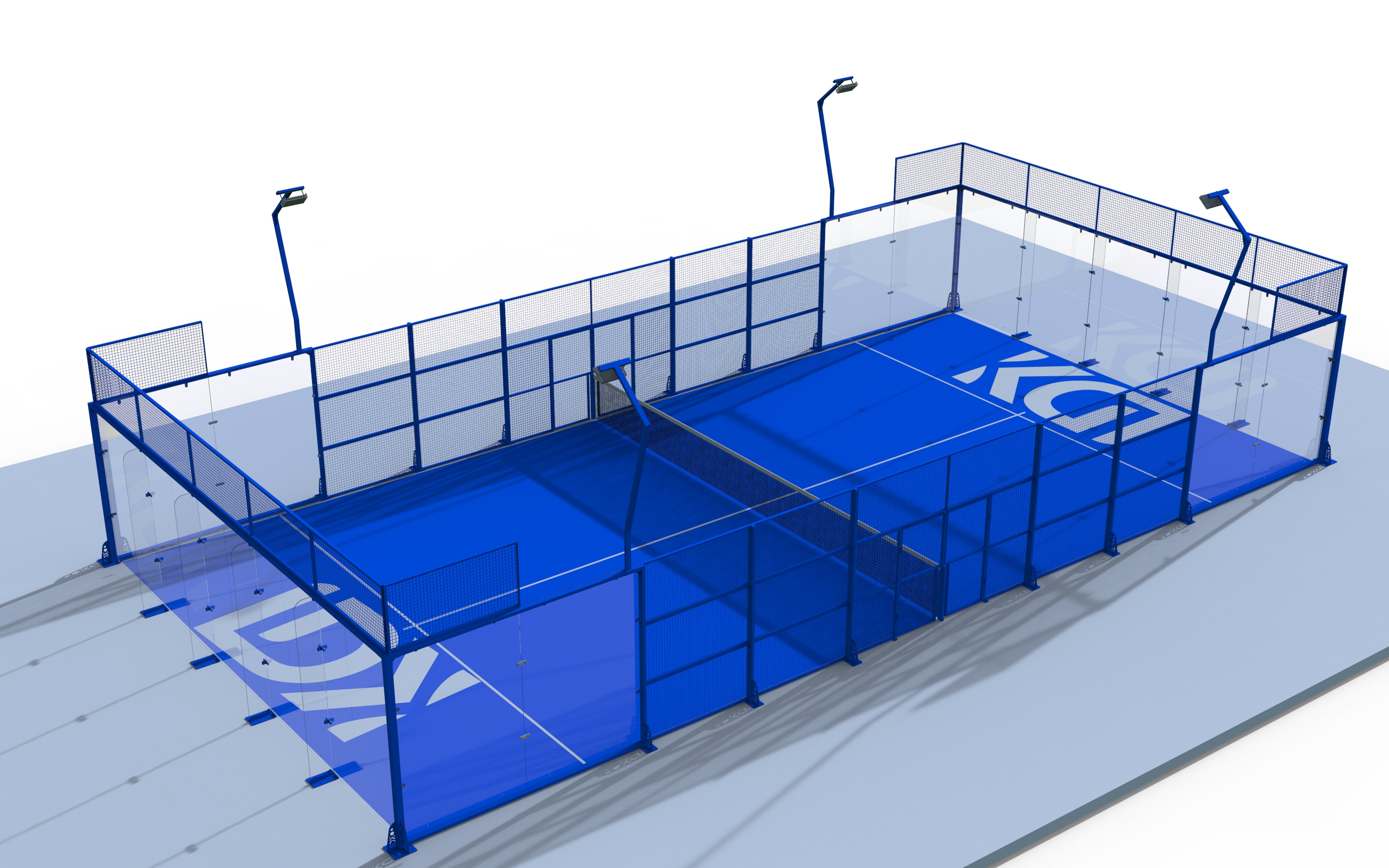
Before talking about a specific model, it helps to confirm the sport-level reference. The International Padel Federation (FIP) defines official padel court dimensions as 20m x 10m with a tolerance of 0.5%. The minimum recommended ceiling height mentioned in padel facility planning is 6m, while 9–12m is often recommended for professional play.
Material choices are also moving toward safer glazing. In 2026, 12mm tempered safety glass is widely treated as the new industry standard for premium panoramic padel courts, replacing the earlier 10mm option. LDK follows this direction in its padel court products, which use 12mm-thick, 1990mm x 2980mm ultra-clear tempered safety glass panels. The glass is specified with an extremely low spontaneous breakage rate of one in 10,000 panels. For export projects in Australia, New Zealand, or the United States, LDK also refers to a requirement list that includes FIP standards, CE certification to EN ISO 12100, and AS 2208 (SGS) certified safety glass.
Padel Court Construction Options: Standard, Panoramic, and Roofed Designs
Padel court construction is not a single fixed formula. It is a package composed of steel structure, glass or wire mesh enclosure, net posts, lighting, and artificial grass. A manufacturer such as LDK expresses this through different product configurations.
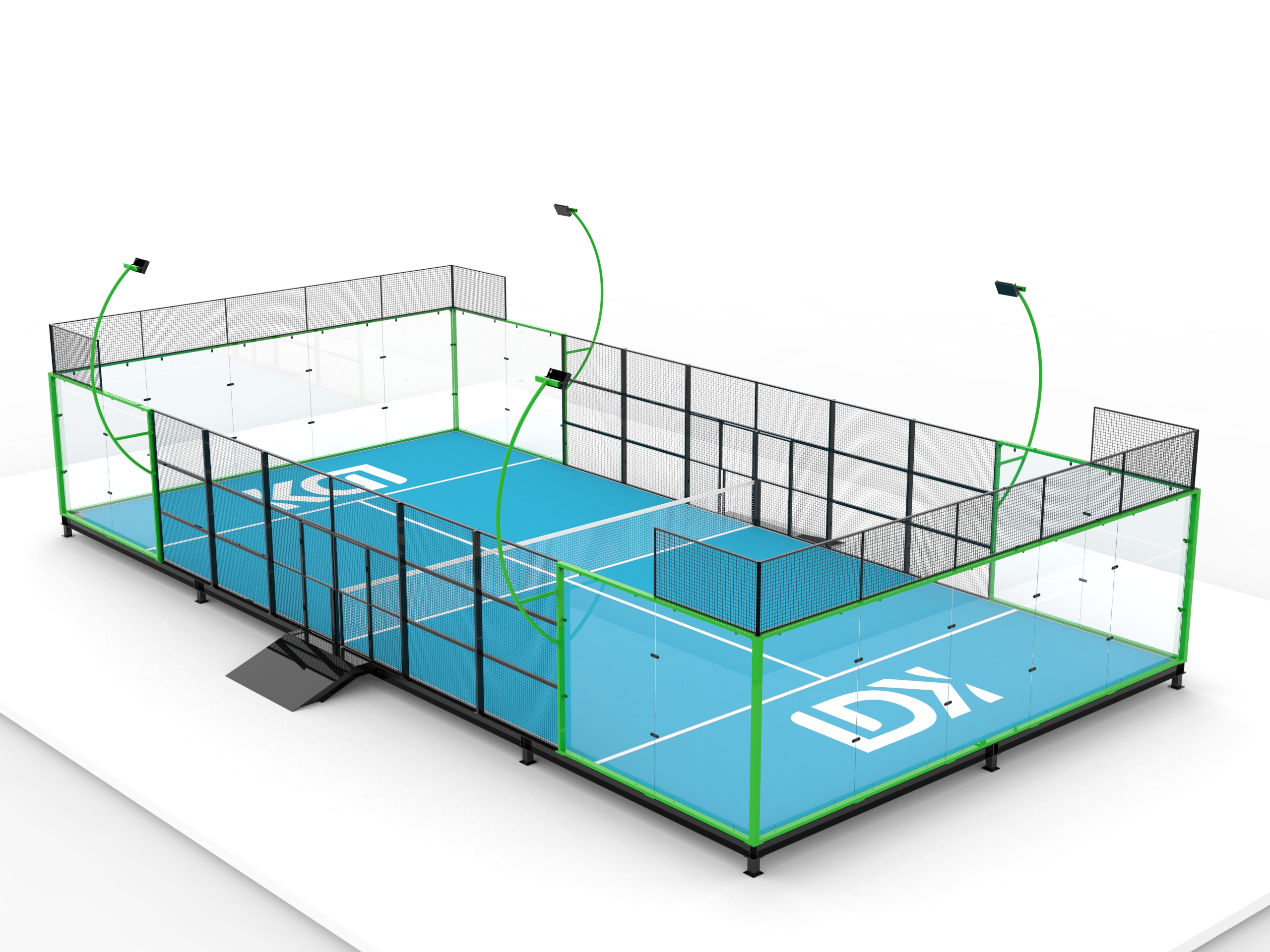
1. Standard Open Padel Court — LDK-PD01
LDK-PD01 is a padel court model constructed from steel and glass for the sports industry. Its perimeter enclosure uses 12mm-thick, 1990mm x 2980mm ultra-clear tempered safety glass. The structural system includes 4m-high corner posts made of 100mm x 100mm x 5mm steel, intermediate and gate posts of 100mm x 50mm x 3mm, and horizontal steel tubing of 100mm x 50mm x 3mm in lengths of 4m, 6m, and 4m. Steel wire mesh panels measure 1m x 2m, with a 4.0mm wire diameter and 50mm x 50mm mesh openings.
For match equipment, the court includes 940mm-high net posts made from 120mm x 60mm x 3mm steel, plus a 10m-long, 92cm-high black polypropylene net with a 4mm cord diameter and 45mm x 45mm mesh openings. The lighting package uses 100mm x 50mm x 3mm light posts and 200W LED fixtures rated at IP65 for outdoor protection. This type of court is appropriate for clubs and sports facilities that want clear visibility, strong steel framing, and the more conventional open-court feel.
2. Panoramic Padel Court With Roof — LDK-PADEL-RF01
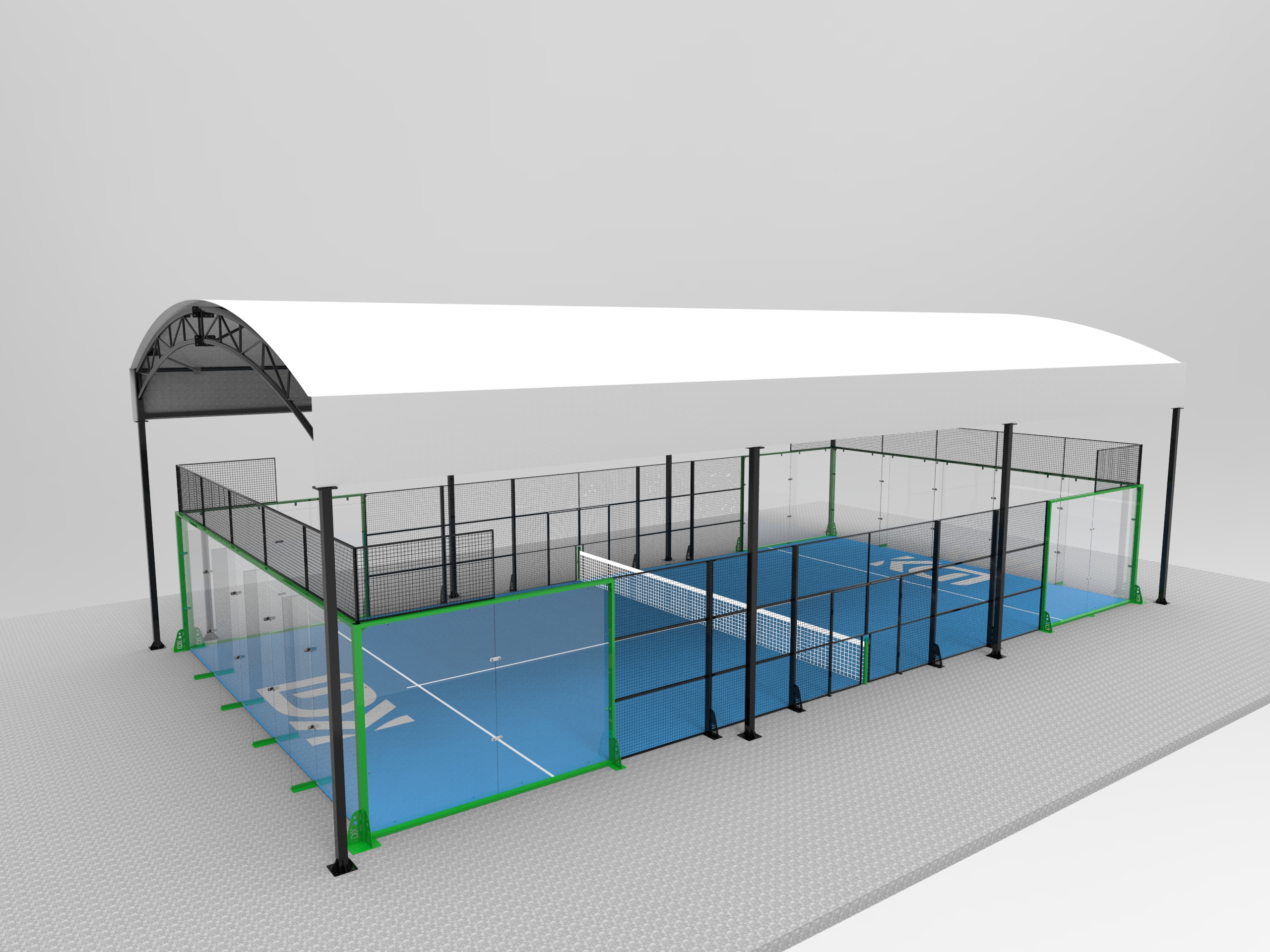
LDK-PADEL-RF01 is a panoramic padel court with roof designed for sports and recreation scenarios. The court dimensions follow the standard padel playing area: 20m in length and 10m in width. Its construction uses hot-dip galvanized carbon steel, safety tempered glass, PVC-coated PVDF fabric, PP artificial grass, and stainless steel hardware.
One of the most important features is the roof system. The roof fabric is a 750g/m² double PVC-coated PVDF material with a service life of 10–15 years. The court is designed with an eaves height of 7m and a ridge height of 9.2m. This provides a much taller interior volume than the minimum 6m ceiling guideline, which helps players, lighting placement, and air circulation.
The steel frame is also engineered for demanding outdoor conditions. Corner columns use 150mm x 200mm x 4mm hot-galvanized steel tube, while middle columns use 100mm x 50mm x 3mm steel tube. The steel structure is rated for wind resistance at Level 10–13 typhoon conditions. Surface treatment combines hot-dip galvanizing and electrostatic epoxy powder coating at 70–80 microns thickness. These details matter to buyers who cannot afford structural failure in their first padel investment.
A roofed panoramic court is particularly practical for facilities in rainy, windy, or high-sun regions. It allows the operator to continue offering play during uncomfortable weather, while the panoramic glass enclosure keeps the court visually open for spectators and television or social media coverage.
3. Artificial Grass for Padel Courts — LDK1231625.4-ST3
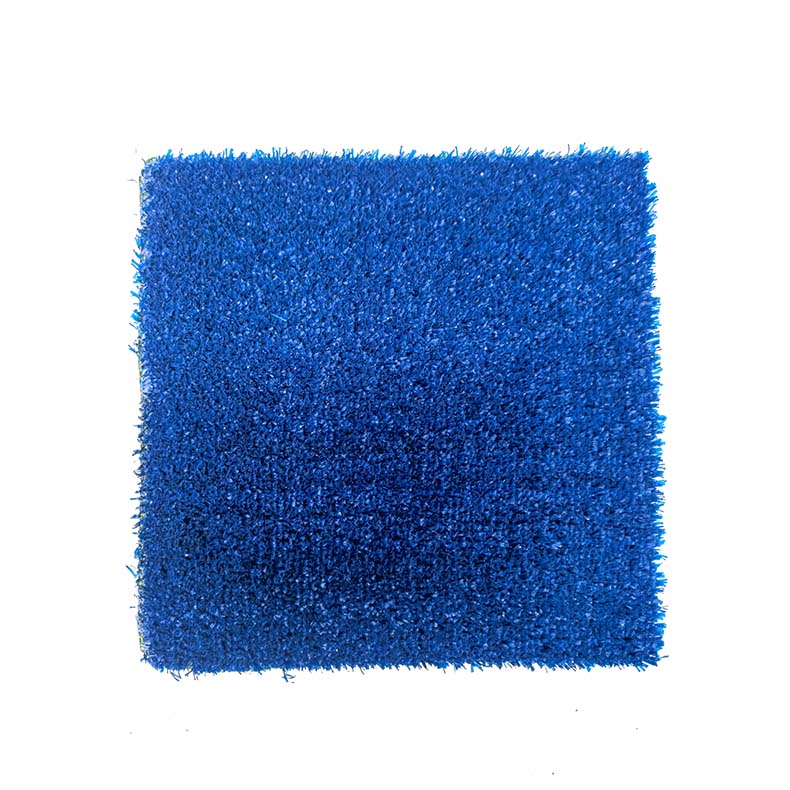
The playing surface is part of the padel court construction package. LDK1231625.4-ST3 is a purpose-made padel grass using polyethylene yarn with double PP and PU latex backing. Its main specifications include a 12mm pile height, 9000 Dtex yarn density, 3/16-inch gauge, and 58,800 stitches per square meter, with a tolerance of ±10%. Available colors are blue, red, green, pink, and black.
Padel grass is not only a visual layer. The fiber type, pile height, density, and backing influence ball bounce, player grip, drainage, and long-term wear. In the LDK roofed panoramic court, the artificial grass system is specified in blue with a 12mm pile height, 63,000 tufts per square meter, 9000D yarn, and PP+NET backing. This shows that padel surface specifications can vary according to the court model and project requirement.
Manufacturer Capability Behind Padel Court Construction
Facility buyers are not only purchasing products; they are also purchasing manufacturing capability. A padel court supplier should be able to handle steel fabrication, glass sourcing, artificial grass, lighting integration, surface treatment, export logistics, and quality certification. The LDK company profile demonstrates the types of evidence a buyer can look for when evaluating a padel court factory.
SHENZHEN LDK INDUSTRIAL CO., LTD. was established in 2014 and describes itself as an integrated sports equipment manufacturer engaged in R&D, production, and sales. The company employs approximately 107 staff and operates a manufacturing facility covering 50,000 square meters. Its annual production capacity reaches 223,750 sets across its sports product lines. The R&D team consists of 17 engineers, and LDK states that new product development can be completed in as few as 10 days.
LDK exports 100% of its products, with major markets in North America, South America, Europe, and Southeast Asia. The company reports more than 11 years of export experience. It holds ISO 9001, ISO 45001, ISO 14001, and CE certifications. For sports facility projects in Australia, New Zealand, and the United States, LDK also identifies a need to comply with FIP standards, CE certification to EN ISO 12100, and AS 2208 (SGS) certified safety glass where applicable. Buyers can use these facts to assess whether a manufacturer has the mature systems needed for padel court construction.
Step-by-Step Process for Choosing a Padel Court Configuration
The following sequence can help project owners move from an abstract idea to a clear technical brief.
Step 1: Define the Operating Environment
Identify whether the court will be used in outdoor, high-traffic, all-weather environments or in a sheltered multi-sport building. Many padel courts in countries such as Australia, New Zealand, and the United States are designed for outdoor use and continuous operation. If rain or wind is a serious issue, evaluate a roofed padel court model. If the court will sit in a multi-sport complex with minimal weather exposure, an open panoramic court may be sufficient.
Step 2: Choose the Enclosure Concept
Decide between a standard padel court enclosure and a panoramic padel court enclosure. The LDK-PD01 standard court combines 12mm tempered glass with steel wire mesh panels. A full panoramic roofed model, such as LDK-PADEL-RF01, uses glass as the main perimeter enclosure and adds overhead protection. The choice depends on spectator experience, marketing value, security, and site exposure.
Step 3: Select the Roofing Strategy
If a roof is selected, confirm the structural standard with the manufacturer. Check column sizes, roof membrane weight and lifespan, drainage, and wind resistance. The LDK-PADEL-RF01 uses 150mm x 200mm x 4mm corner columns, a 750g/m² PVC-coated PVDF roof membrane, and a steel frame rated for Level 10–13 typhoon resistance. These are concrete points to request in a supplier quotation.
Step 4: Specify the Playing Surface and Lighting
Do not leave the artificial grass specification open-ended. Confirm pile height, Dtex, gauge, tuft density, backing material, and color. Lighting should also be included in the scope. Padel court systems such as LDK-PD01 and LDK-PADEL-RF01 can be equipped with 200W LED fixtures rated IP65, which is important for outdoor wet conditions.
Step 5: Audit the Factory and Certification Pack
Ask the manufacturer to show its factory area, production equipment, R&D team size, production capacity, export history, and certificates. In the LDK example, the company has about 107 staff, a 50,000m² facility, a 223,750-set annual production capacity, and 17 R&D engineers. Certifications including ISO 9001, ISO 45001, ISO 14001, and CE provide a verifiable baseline for an international sports project.
Use Cases for Padel Courts in Sports Facilities
Padel courts are used in sports facility construction projects for sports training and competition. According to LDK application references, this product type is suitable for outdoor, high-traffic, all-weather environments and is designed to operate in 24/7 availability mode. Common markets for these applications include Australia, New Zealand, and the United States.
A sports facility developer can combine padel courts with other court systems in the same complex. LDK supplies padel courts, squash courts, soccer pitches, basketball courts, and pickleball courts. This broad portfolio can simplify procurement when a project includes multiple sports. The supporting equipment package for a padel facility normally includes court lighting, fencing, net systems, and padel grass.
Padel Court Construction Comparison Table
| Product | Construction Focus | Main Materials | Typical Scope |
|---|---|---|---|
| Standard Padel Court — LDK-PD01 | Open padel court with glass perimeter and steel wire mesh | Steel, tempered safety glass, steel mesh, polypropylene net, LED lighting | Sports clubs, padel training centers, private facilities |
| Panoramic Padel Court with Roof — LDK-PADEL-RF01 | Panoramic roofed court with steel frame, 12mm glass, and PVDF fabric roof | Hot-dip galvanized carbon steel, safety tempered glass, PVC-coated PVDF fabric, PP artificial grass, stainless steel | Sports and recreation venues, outdoor premium courts, commercial facilities |
| Padel Grass — LDK1231625.4-ST3 | Purpose-made artificial playing surface | Polyethylene yarn with double PP and PU latex backing | Padel courts, padel/tennis facilities, recreational projects |
Frequently Asked Questions about Padel Court Construction
1. What official dimensions and standards apply to padel court construction?
The International Padel Federation (FIP) sets official padel court dimensions at 20m x 10m, with a tolerance of 0.5%. The minimum indoor ceiling height often cited for courts is 6m, although 9–12m is recommended for professional play. For premium padel courts, 12mm tempered safety glass is becoming the expected choice, and exporting manufacturers increasingly certify to standards such as CE and AS 2208. LDK uses 12mm, 1990mm x 2980mm ultra-clear tempered safety glass panels in its padel court constructions and references compliance with FIP standards, CE certification to EN ISO 12100, and AS 2208 (SGS) certified safety glass for relevant export zones.
2. What padel court type should a facility choose: standard, panoramic, or roofed?
The choice depends on the site, climate, budget, and planned usage. A standard padel court model such as LDK-PD01 is built with steel and 12mm tempered glass plus wire mesh, and works well for training and club play. A panoramic court with roof, such as LDK-PADEL-RF01, adds overhead protection and a fully open glass look, with an eaves height of 7m and ridge height of 9.2m. Roofed panoramic courts are useful in high-sun, rainy, or windy locations. The same manufacturer can provide different configurations, so a buyer may standardize on one brand while mixing court types across a facility.
3. Which factors determine the budget of a padel court construction project?
A padel court budget is driven by specific construction components rather than by one generic price. Key factors include the steel post and beam dimensions, glass thickness and enclosure type, use of a roof membrane, artificial grass specification, lighting class, surface treatment, and whether the project requires stainless steel hardware. Roof membranes with a 10–15 year service life and steel structures designed for high wind resistance add value but change the cost position. Buyers should compare itemized product specifications, not only the total court price.
4. How can certification and factory evidence help a buyer verify padel court quality?
Padel court buyers should ask for verifiable production information. This may include the manufacturer's factory area, number of employees, R&D team size, annual production capacity, export experience, and management-system certification. For example, SHENZHEN LDK INDUSTRIAL CO., LTD. reports about 107 staff, a 50,000-square-meter manufacturing facility, annual capacity of 223,750 sets, and 17 R&D engineers. The company holds ISO 9001, ISO 45001, ISO 14001, and CE certifications. A serious manufacturer can also provide product drawings, artificial grass samples, glass documentation, and reference installations for review before a project decision.
5. Can one sports equipment manufacturer handle a multi-court project or delivery schedule?
An integrated manufacturer with a diversified sports court portfolio is generally better positioned to manage multi-court projects. LDK specializes in padel courts and also supplies squash courts, soccer pitches, basketball courts, and pickleball courts, allowing buyers to group orders in one factory. The company has over 11 years of export experience and states that export business accounts for 100% of total sales, with major markets in North America, South America, Europe, and Southeast Asia. For current lead times and scheduling on a specific project, it is advisable to contact LDK directly with the court model, quantity, and destination.
Conclusion: Build the Right Padel Court From the First Project Brief
Padel court construction involves more than marking a 20m x 10m area and adding a net. Buyers need to decide on glass enclosures, steel frames, roof systems, artificial grass, lighting, and manufacturer certifications. A comparison between a standard open padel court and a panoramic roofed padel court highlights how different models serve different operating goals. The same brand can supply both, which simplifies maintenance, spare parts, and project coordination.
For project teams beginning their padel court research, a useful next step is to review LDK's company and product documentation. The downloadable LDK brochure contains more details about the factory, product range, and contact channel.
Next step: Request LDK's padel court brochure and product drawings to compare specifications for your facility.
Company: SHENZHEN LDK INDUSTRIAL CO., LTD.
Website: www.ldkchina.com
Brochure: Download LDK Company Brochure
Sales contact: Anna — Email: anna@ldkchina.com — Tel/WhatsApp: +86 15219504797
Have Questions or Need More Details?
Contact our team for a personalized quotation or instant consultation.
Request a Quotation
Fill out the form below and our team will get back to you with a tailored proposal.
WhatsApp Direct Chat
Prefer to chat in real-time? Message us on WhatsApp for instant assistance & quick answers.
- Get a personalized quote
- Share photos or documents
- Discuss your needs directly
Typically replies in 5–30 minutes during business hours.