
Padel Court Explained: Court Types, Core Components, and Materials for Facility Planners
A padel court is a 20 m x 10 m playing area enclosed by a steel and tempered-glass perimeter, fitted with a net system, an LED lighting system, and an artificial grass surface. For a facility planner, that sentence is only the starting point: the same category covers a bare standard glass court and a fully roofed panoramic court, and the material choices inside those two formats decide how long a court stays playable, how much maintenance it absorbs, and whether it can host competitive play.
This explainer breaks the padel court into the parts a planner actually has to specify — court type, enclosure, net, lighting, surface, and roof — and matches each part to verified specifications. The reference models used throughout are the LDK standard padel court (LDK-PD01), the panoramic padel court with roof (LDK-PADEL-RF01), and the padel grass range (LDK1231625.4-ST3).
Shenzhen LDK Industrial Co., Ltd. (LDK) is a Chinese sports equipment manufacturer founded in 2014 that develops and produces padel courts, football pitches, squash courts, basketball courts, and pickleball courts, and exports its full output from R&D and manufacturing bases in Huizhou and Cangzhou, with its strongest presence in North America, South America, Europe, and Southeast Asia.
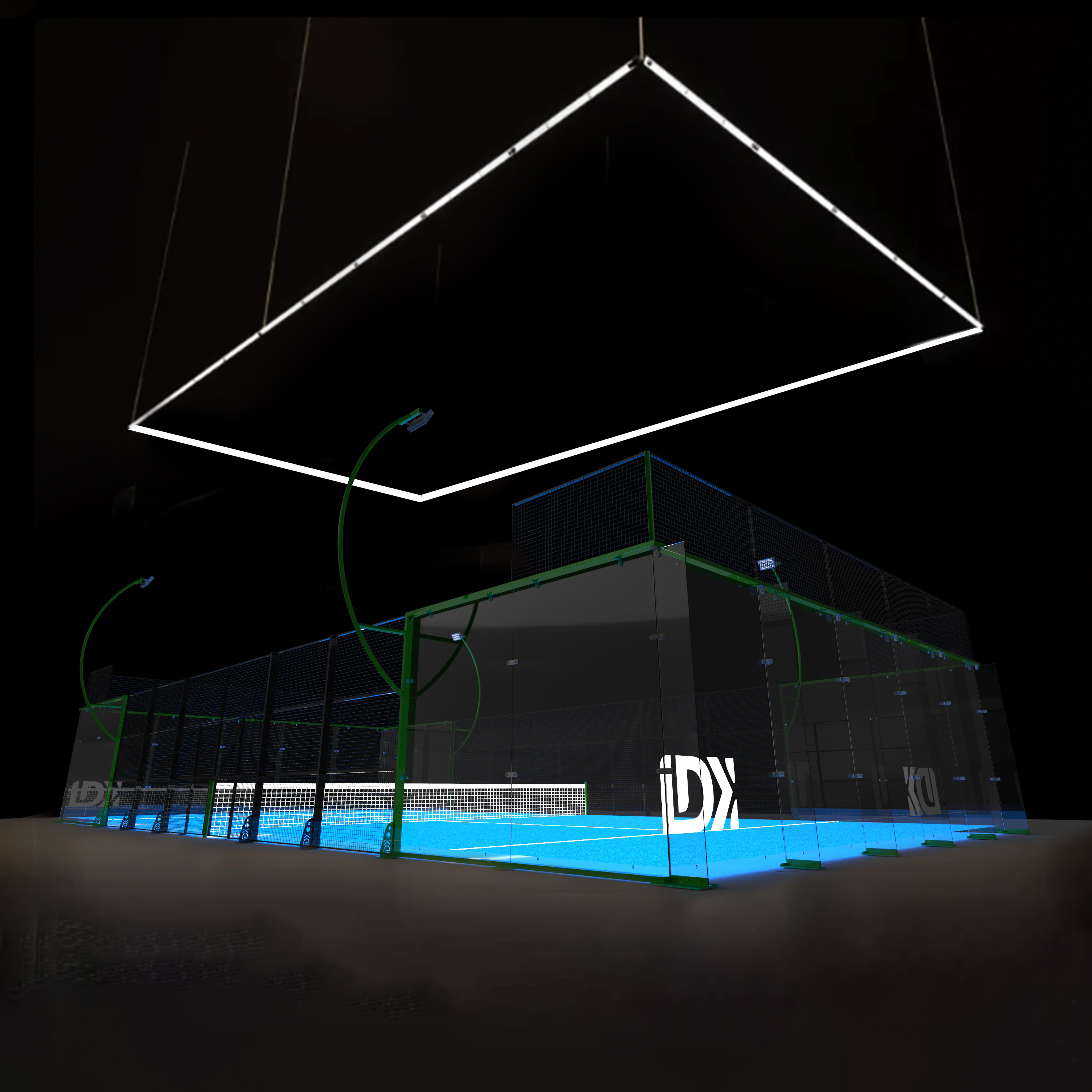
Panoramic padel tennis court: the glass enclosure format that defines court dimensions, play behaviour, and safety requirements.
The Planning Problem: Padel Court Is Not a Single Product
Facility planners hit the same definitional gap on almost every padel project. A tender package arrives with the words padel court written on it, and three suppliers quote three different scopes: one prices only the artificial grass and net, one prices only the glass enclosure, and one prices the complete structure including lighting and roof. Because none of them define the term the same way, the quotes are not comparable and the budget line is meaningless.
Three specific ambiguities cause most of the confusion:
- Format ambiguity. A standard glass court and a panoramic court with a roof use different structures, different steel sections, and different wind-load assumptions. They are not interchangeable, and a quotation that does not name the format cannot be evaluated.
- Scope ambiguity. Court may mean the enclosure alone, or the enclosure plus net, lighting, and surface. Component-level scope has to be itemized before pricing is compared.
- Terminology ambiguity. The sport is written as both padel and paddle, and padel courts are frequently confused with neighbouring categories such as pickleball courts, squash courts, tennis courts, and outdoor football or soccer facilities. A padel court is a glass-walled enclosure built to the FIP playing area; the others are separate facility types with their own dimensions, surfaces, and equipment.
The practical consequence is that court definition has to happen before procurement, not during it. The specification is the document that makes bids comparable, and it can only be written once the court types and components are clear.
Industry Background: Why Court Definitions Are Being Tested Now
Padel infrastructure has moved from a niche European activity to a global facility category, and the volumes involved make specification discipline more valuable than it was a few years ago.
- As of early 2025, the global total of padel courts reached approximately 58,334 across nearly 20,000 clubs, a 16% increase year over year, according to Playtomic and Strategy& (Global Padel Report 2026 preview).
- The padel court operator market was valued at approximately USD 3.8 billion in 2025 and is projected to reach USD 9.6 billion by 2034, according to Dataintelo.
- The United States Padel Association projects the U.S. market will reach 30,000 courts and more than 10 million players by 2030, up from roughly 650 courts in early 2025.
Two cautions belong with those numbers. First, third-party market valuations diverge sharply depending on what is included: Dataintelo measures the court operator business, while equipment-focused reports value the same market at a far lower level. Second, a growth projection describes a market, not a site — a planner still has to confirm local demand, land, and permitting before choosing a format.
What the growth does change is the duty cycle buyers are designing for. The LDK application profile for padel courts in Australia, New Zealand, and the United States describes outdoor, high-traffic, all-weather venues available on a 24/7 basis, with matched equipment covering court lighting, fencing, the net system, and padel grass. That is a different operating pattern from a temperate indoor club court, and it is the pattern that pushes material decisions toward certified safety glass, heavy galvanized steel, and weather-rated roof fabric.
Padel Court Types: Standard Glass Court vs Panoramic Court With Roof
Two formats cover most facility planning briefs. Both use a tempered-glass enclosure and both play to the same rules; they differ in structure, height, roof coverage, and cost profile.
The standard glass padel court (LDK-PD01)
The standard court is the baseline format: a steel and tempered-glass perimeter enclosure, a net system, and an LED lighting system, installed on a prepared base and finished with an artificial grass surface. LDK-PD01 is specified around 12 mm ultra-clear tempered safety glass in 1990 x 2980 mm panels, certified to an extremely low spontaneous breakage rate of 1 in 10,000.
Its frame uses 4 m-high 100 x 100 x 5 mm corner posts, 100 x 50 x 3 mm intermediate and gate posts, and 100 x 50 x 3 mm horizontal tubing supplied in 4 m, 6 m, and 4 m lengths. The perimeter is completed with 1 x 2 m steel wire mesh panels using 4.0 mm wire and 50 x 50 mm openings. The equipment package adds 940 mm-high net posts (120 x 60 x 3 mm) and a 10 m-long, 92 cm-high black polypropylene net with a 4 mm cord and 45 x 45 mm mesh openings, plus 100 x 50 x 3 mm light posts carrying 200 W LED fixtures rated IP65.
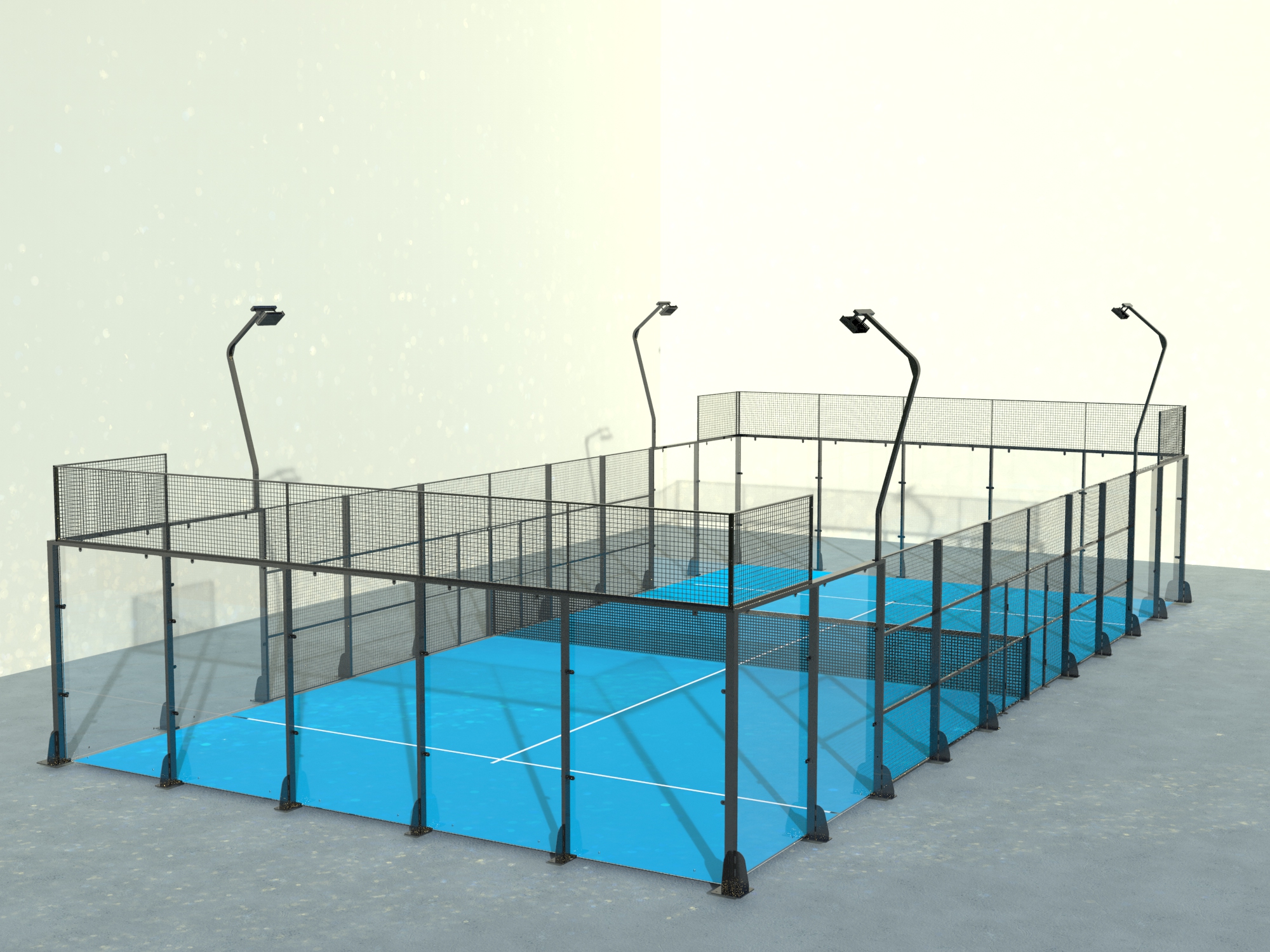
Standard glass padel court: 12 mm tempered safety glass, 4 m corner posts, and a 10 m net system form the base specification.
This format suits outdoor clubs and multi-court facilities where the priority is a weather-exposed, low-maintenance court built on a proven structural system.
The panoramic padel court with roof (LDK-PADEL-RF01)
The panoramic court keeps the glass enclosure but raises the structure and adds a fabric roof, so the court remains usable in rain, strong sun, or high heat without the cost of a full building. LDK-PADEL-RF01 is specified at 20 m (L) x 10 m (W), with an eaves height of 7 m and a ridge height of 9.2 m.
Its steel structure is heavier than a standard court: eight 150 x 200 x 4 mm hot-galvanized corner columns, twelve 100 x 50 x 3 mm middle columns, hot-galvanized beams in Φ102 / Φ89 / Φ40 x 3 mm, and sixteen 100 x 50 x 3 mm cross tubes in 4 m and 6 m lengths, joined with high-strength bolts. Surface treatment is hot-dip galvanizing plus electrostatic epoxy powder coating at 70–80 μm thickness, and the structure is rated for Level 10–13 typhoon wind resistance.
The roof uses 750 g/m² double PVC-coated PVDF fabric with a stated service life of 10–15 years. The enclosure uses 12 mm tempered safety glass in 1990 x 2980 mm panels (18 pieces) plus 46 wire mesh panels at 1 x 2 m, 4 mm wire, and 50 x 50 mm openings. The competition set includes a 980 mm-high post and a 10 m x 970 mm knotted polypropylene net with a 4 mm rope and 50 x 50 mm mesh, with 200 W IP65 LED lighting on 100 x 50 x 3 mm columns and stainless steel electro-polished bolts, nuts, and washers.
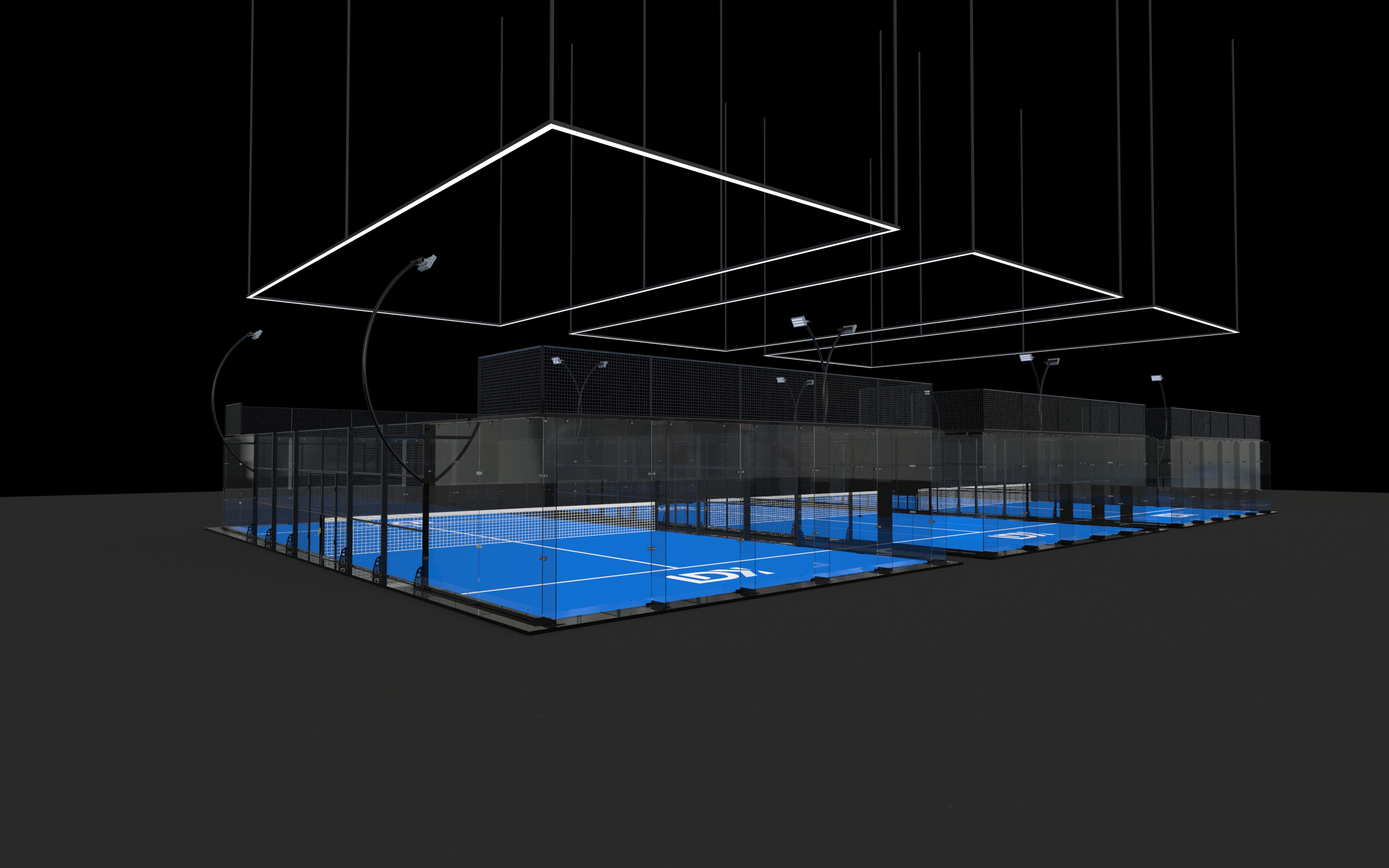
Panoramic padel court with roof: 7 m eaves height, 9.2 m ridge height, and Level 10–13 typhoon wind resistance.
How to choose between the two formats
- Site climate and revenue hours. If the venue is outdoor, in a market with heavy rainfall or intense sun, and the business case depends on booking hours through the whole year, the roofed panoramic format is the fit.
- Site with existing shade. If the site already has a shade structure or a mild climate, a standard glass court delivers the same play format at a lower structural cost, and a roof can be added later as a separate project.
- Competitive play requirements. The International Padel Federation (FIP) sets a minimum indoor ceiling height of 6 m and recommends 9–12 m for professional play — a benchmark worth checking against any roofed structure before it is specified.
Core Components of a Padel Court
Whatever the format, a padel court resolves into five component groups. Specifying them individually is what keeps supplier quotations comparable.
1. Enclosure: frame, glass, and wire mesh
The enclosure is what makes a court a padel court rather than a fenced sports area. It combines a structural steel frame, tempered glass panels at the playing face, and wire mesh panels that close the remaining perimeter. In LDK-PD01 the frame is 100 x 100 x 5 mm at the corners and 100 x 50 x 3 mm elsewhere, with 1 x 2 m mesh panels at 4.0 mm wire and 50 x 50 mm openings. Glass thickness is the most consequential choice in this group: 12 mm tempered safety glass has become the industry standard for premium panoramic padel courts, replacing the previous 10 mm specification for enhanced safety and more consistent ball rebound.
2. Net and post set
Net specifications differ slightly between formats. LDK-PD01 uses a 940 mm-high post in 120 x 60 x 3 mm steel and a 10 m-long, 92 cm-high black polypropylene net with 4 mm cord and 45 x 45 mm mesh. LDK-PADEL-RF01 uses a 980 mm-high post and a 10 m x 970 mm knotted polypropylene net with 4 mm rope and 50 x 50 mm mesh. Both are supplied as part of the court package, which matters because a net sourced separately may not match the post spacing of the enclosure.
3. Lighting
Both reference courts use 200 W LED fixtures rated IP65 — the ingress protection rating that matters for outdoor venues exposed to rain and dust — mounted on 100 x 50 x 3 mm columns. Lighting usually determines whether the court can be booked for evening sessions, so it belongs in the base specification rather than in the optional add-on list.
4. Playing surface
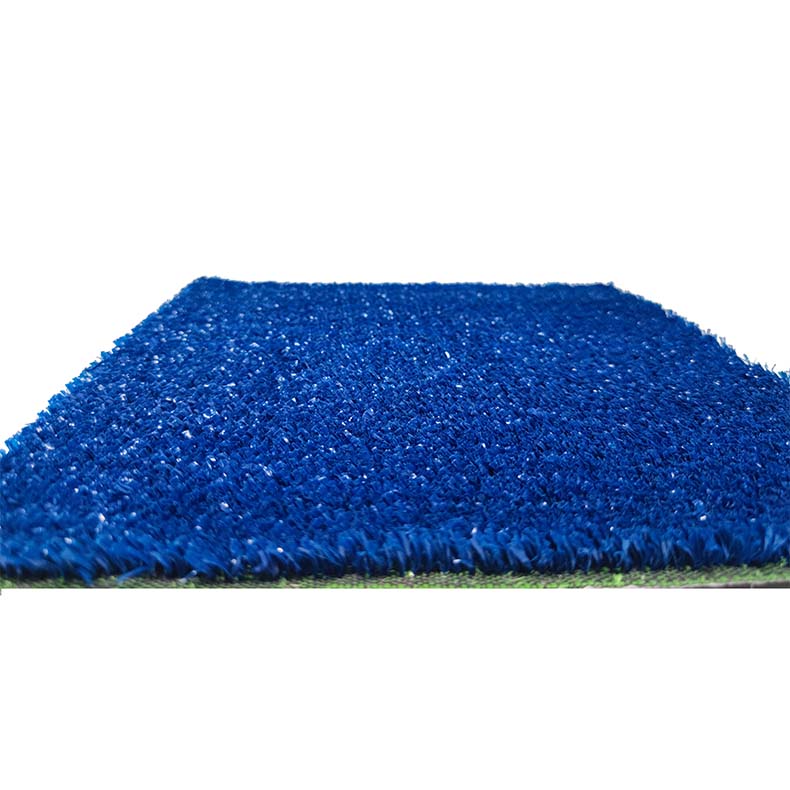
The playing surface is padel artificial grass, supplied as a separate specification item. LDK padel grass (LDK1231625.4-ST3) uses a 12 mm pile height, 9,000 Dtex polyethylene yarn, a 3/16 inch gauge, and a double PP + PU latex backing, with a density of 58,800 stitches/m² (±10%). The panoramic court package specifies a 12 mm blue grass with 63,000 tufts/m², 9,000D yarn, and PP + NET backing.
5. Roof and canopy structure
Where a roof is used, it behaves as a structural component rather than an accessory. The columns, beams, and cross tubes are sized to carry both fabric load and wind load, and in the case of LDK-PADEL-RF01 the structure is rated for Level 10–13 typhoon conditions. Fabric weight (750 g/m² here), coating type (double PVC-coated PVDF), and stated service life (10–15 years) are the three specifications that separate a durable canopy from a temporary cover.
Materials That Determine Service Life
Tempered safety glass
Glass defines both safety and rebound consistency. LDK-PD01 and LDK-PADEL-RF01 both use 12 mm tempered safety glass in 1990 x 2980 mm panels, with the standard court certified to a spontaneous breakage rate of 1 in 10,000. Where the project targets the Australia and New Zealand market, the application profile calls for AS 2208 (SGS) certified safety glass.
Hot-galvanized steel and surface treatment
Structural steel carries the enclosure and, in a roofed court, the canopy. The panoramic structure uses hot-galvanized carbon steel that receives hot-dip galvanizing plus electrostatic epoxy powder coating at 70–80 μm — a two-stage treatment aimed at corrosion control on outdoor installations. The standard court uses 100 x 100 x 5 mm corner posts and 100 x 50 x 3 mm intermediate members, with stainless steel electro-polished bolts, nuts, and washers at the connections.
Roof fabric
The roof membrane is 750 g/m² double PVC-coated PVDF, with a stated service life of 10–15 years. Fabric weight and coating system are the two variables a planner can compare directly between suppliers.
Padel artificial grass
Surface performance depends on pile height, yarn type, gauge, backing, and density. LDK1231625.4-ST3 combines a 12 mm pile, 9,000 Dtex polyethylene yarn, a 3/16 inch gauge, a double PP + PU latex backing, and a density of 58,800 stitches/m² (±10%), and is available in blue, red, green, pink, and black — a colour range that allows clubs to differentiate courts or match an existing brand palette.
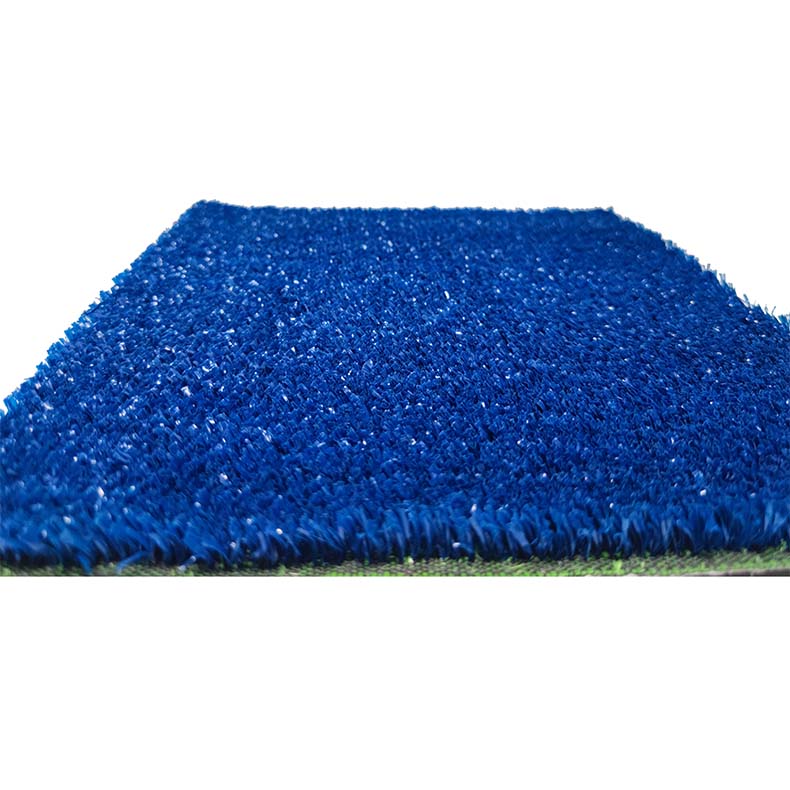
Padel grass specification: 12 mm pile height, 9,000 Dtex yarn, 3/16 inch gauge, and 58,800 stitches/m² density.
Netting and hardware
The net itself is polypropylene — 4 mm cord with 45 x 45 mm mesh on the standard court, and 4 mm rope with 50 x 50 mm mesh on the roofed panoramic court — while bolts, nuts, and washers are stainless steel electro-polished. These are small line items that are frequently downgraded in a competitive bid and are expensive to correct after installation.
Step-by-Step: How to Specify a Padel Court
- Confirm the playing area and site conditions. FIP defines the official playing area as 20 m x 10 m with a 0.5% tolerance, and sets a minimum indoor ceiling height of 6 m with 9–12 m recommended for professional play. Verify base, drainage, and access before anything else.
- Select the format. Standard glass court or panoramic court with roof — decided by climate, operating hours, and whether the venue needs to stay bookable in poor weather.
- Fix the enclosure specification. Glass thickness and panel size, corner and intermediate post sections, mesh panel size, and connection hardware.
- Fix the surface specification. Pile height, yarn Dtex, gauge, backing construction, density tolerance, and colour.
- Fix lighting and power. Fixture wattage, IP rating, and column section — 200 W LED at IP65 on 100 x 50 x 3 mm columns is the LDK baseline.
- Collect compliance documentation. FIP playing dimensions, CE marking under EN ISO 12100, AS 2208 (SGS) certified safety glass where applicable, and the manufacturer's ISO 9001, ISO 14001, and ISO 45001 certificates.
- Lock commercial terms. Minimum order quantity, lead time, quality control process, and warranty period — these determine whether a specification can actually be delivered.
Commercial terms to compare. LDK operates OEM/ODM production with customization of court size, colour, logo printing, surface material, fencing design, and lighting configuration; a minimum order quantity of 1 unit; a monthly capacity of 200 units; a 30–45 day lead time; 100% testing before shipment; and a 1–5 year warranty. These terms are what separate a specification that can be met from one that has to be renegotiated after the order is placed.
Use Cases: How the Specification Translates Into Operations
A 16-court padel club in Chile. An automotive OEM client installed 16 LDK padel courts for a padel club. The venue has run stably for three years, and the client reports that the courts are extremely durable, require almost no maintenance, and can be used throughout the year.
A 70-court padel project in Bangladesh. An automotive ODM client took delivery of 70 padel court units, also operating stably for three years, with FIP and CE certification cited as the assurance of quality and safety across the installation.
Outdoor, all-weather venues in Australia, New Zealand, and the United States. LDK's application profile for this scenario describes outdoor, high-traffic, all-weather sports facilities running on a 24/7 basis, with matched equipment covering court lighting, fencing, the net system, and padel grass, and special requirements covering compliance with FIP standards, CE certification (EN ISO 12100), and AS 2208 (SGS) certified safety glass.
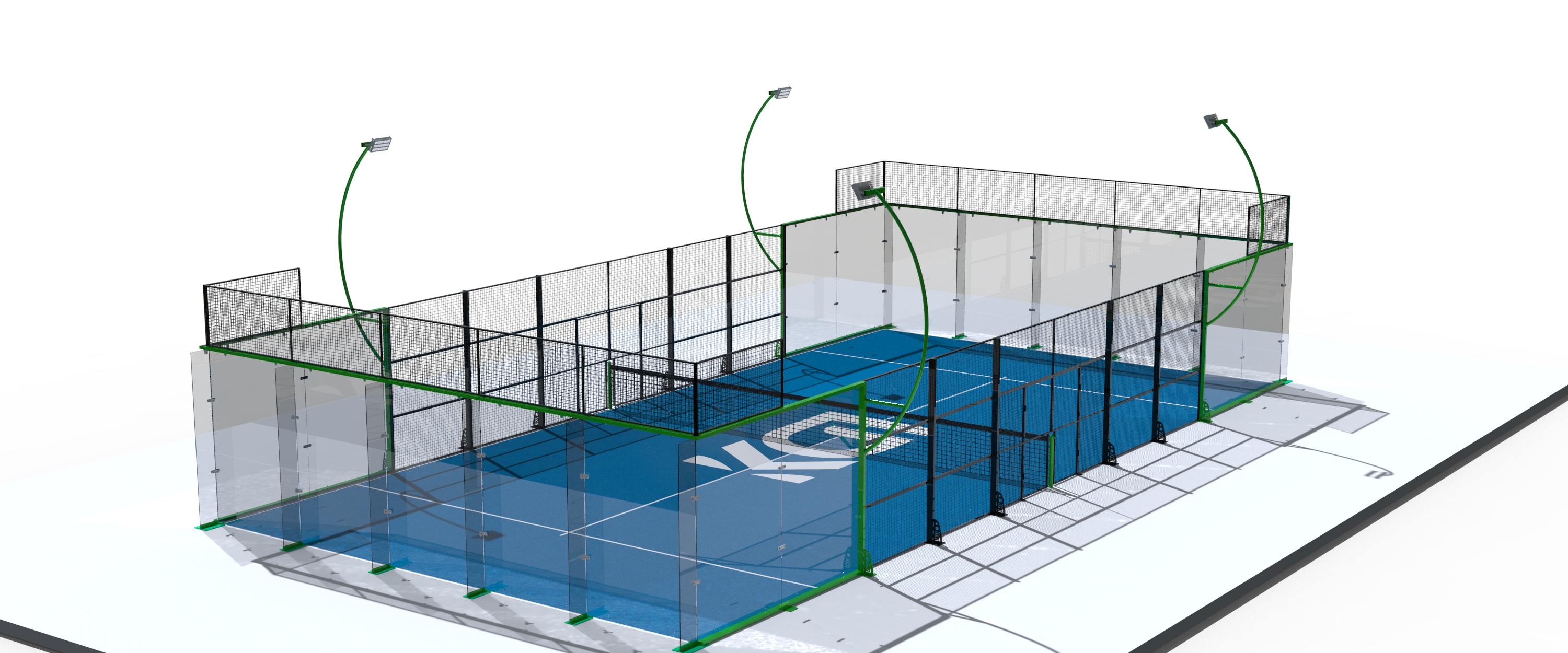
Multi-court club deployment: repeated court units specified to a single enclosure, surface, and lighting standard.
Investment context. A third-party analysis by WePadel estimates that a panoramic padel court investment can return its cost within 12 to 18 months in high-demand urban locations, based on 70–90% peak occupancy rates. That figure is a market estimate rather than a guaranteed outcome, and it should be re-tested against local pricing, demand, and operating cost before it is used in a business case.
Standard vs Panoramic Court: Side-by-Side Specification
The table below compares the two LDK court formats on the parameters a planner needs to fix before requesting quotations. Values are taken from the published product specifications for LDK-PD01 and LDK-PADEL-RF01.
| Parameter | Standard Padel Court (LDK-PD01) | Panoramic Padel Court With Roof (LDK-PADEL-RF01) |
|---|---|---|
| Playing area | Follows FIP playing dimensions (20 m x 10 m, 0.5% tolerance) | 20 m (L) x 10 m (W) |
| Height | 4 m corner posts | 7 m eaves height, 9.2 m ridge height |
| Enclosure glass | 12 mm ultra-clear tempered safety glass, 1990 x 2980 mm panels, 1 in 10,000 breakage rate | 12 mm tempered safety glass, 1990 x 2980 mm panels, 18 pieces |
| Corner columns | 100 x 100 x 5 mm, 4 m high | 150 x 200 x 4 mm hot-galvanized tube, 8 pieces |
| Intermediate / middle columns | 100 x 50 x 3 mm intermediate and gate posts | 100 x 50 x 3 mm tube, 12 pieces |
| Horizontal members | 100 x 50 x 3 mm tubing in 4 m, 6 m, 4 m lengths | Beams Φ102 / Φ89 / Φ40 x 3 mm; cross tubes 100 x 50 x 3 mm (4 m / 6 m), 16 pieces |
| Wire mesh | 1 x 2 m panels, 4.0 mm wire, 50 x 50 mm openings | 1 x 2 m panels, 4 mm wire, 50 x 50 mm openings, 46 pieces |
| Surface treatment | Steel frame with stainless steel electro-polished hardware | Hot-dip galvanizing + electrostatic epoxy powder coating, 70–80 μm |
| Wind resistance | Not specified in the quoted data | Level 10–13 typhoon |
| Roof / canopy | None | 750 g/m² double PVC-coated PVDF fabric, 10–15 year service life |
| Net system | 10 m net, 92 cm high, black PP, 4 mm cord, 45 x 45 mm mesh; 940 mm posts (120 x 60 x 3 mm) | 10 m x 970 mm knotted PP net, 4 mm rope, 50 x 50 mm mesh; 980 mm posts |
| Lighting | 200 W LED, IP65, on 100 x 50 x 3 mm light posts | 200 W LED, IP65, on 100 x 50 x 3 mm columns |
| Artificial grass | Matched with LDK padel grass (LDK1231625.4-ST3) | 12 mm blue pile, 63,000 tufts/m², 9,000D yarn, PP + NET backing |
| Typical fit | Mild-climate or shaded outdoor sites; budget-controlled phased projects | All-weather venues requiring year-round booking hours |
FAQ: Padel Court Specification and Procurement Questions
Which standards and certifications should a padel court meet?
A padel court should be built to the FIP playing area of 20 m x 10 m with a 0.5% tolerance, and where it is installed under a roof, the FIP minimum indoor ceiling height of 6 m applies (9–12 m is recommended for professional play). Beyond dimensions, the compliance set that matters in tender documents is CE marking under EN ISO 12100 for machinery safety, AS 2208 (SGS) certified safety glass for projects in Australia and New Zealand, and 12 mm tempered safety glass — now the industry standard for premium panoramic courts, having replaced the earlier 10 mm specification. LDK holds ISO 9001, ISO 45001, ISO 14001, and CE certifications for its sports equipment production.
Can a padel court be customized to a specific site or brand?
Yes. LDK operates OEM/ODM production with customization covering court size, colour, logo printing, surface material, fencing design, and lighting configuration. The minimum order quantity is 1 unit, monthly capacity is 200 units, and the company's 17 R&D engineers can complete new product development in as few as 10 days when a project requires a non-standard configuration. That combination — single-unit MOQ plus genuine customization — is what allows a planner to run a pilot court before committing to a multi-court build.
What drives the cost of a padel court project?
Five variables dominate: whether the court carries a roof structure, glass thickness and panel count, steel sections and surface treatment, the artificial grass specification (pile height, Dtex, gauge, and backing), and the lighting package. Roofed panoramic courts sit above standard courts because the columns, beams, cross tubes, and PVDF fabric are additional structural items. For context, the global padel court operator market was valued at approximately USD 3.8 billion in 2025 and is projected to reach USD 9.6 billion by 2034 (Dataintelo), and a WePadel analysis estimates panoramic court ROI within 12–18 months in high-demand urban areas at 70–90% peak occupancy — a market estimate that should be validated against local conditions rather than used as a fixed planning assumption.
How can materials be validated before committing to a full project?
The most direct route is a minimum order quantity of 1 unit, which allows a single court to be built and inspected before a multi-court order is released, combined with LDK's 100% testing before shipment. Documented materials, published specifications for glass, steel, roof fabric, and grass, and reference projects in comparable operating conditions support the decision: a 16-court club in Chile that has run stably for three years, and a 70-unit project in Bangladesh with three years of stable operation. Full product documentation is available in the LDK product brochure.
What lead time and warranty terms apply?
LDK quotes a 30–45 day lead time against a monthly capacity of 200 units, with 100% testing before shipment and a warranty of 1 to 5 years depending on the configuration. For a project already moving into the evaluation stage, the fastest next step is to send the site dimensions, the intended format (standard or panoramic with roof), and the target operating schedule; LDK can then return a specification-matched quotation. Requests can be sent to anna@ldkchina.com or through WhatsApp on +86 15219504797.
Conclusion: Define the Court Before You Price It
A padel court is a defined product — a 20 m x 10 m playing area enclosed in tempered glass and hot-galvanized steel, with a net system, IP65 LED lighting, and a 12 mm artificial grass surface. The planner's job is not to define the sport but to decide which configuration of that product fits the site: a standard glass court such as LDK-PD01 where climate is manageable and budget is staged, or a roofed panoramic court such as LDK-PADEL-RF01 where the venue must stay bookable in rain, heat, and Level 10–13 typhoon wind conditions.
Once the format is fixed, the rest of the specification follows in a predictable order: enclosure sections and glass, net and posts, lighting, surface, roof, and compliance documentation. Written that way, the specification makes supplier quotations comparable, keeps material substitution out of the delivery phase, and gives the facility a court that performs the way the business case assumed it would.
LDK manufactures padel courts, padel grass, and the surrounding range of sports court systems from its bases in Huizhou and Cangzhou, with 17 R&D engineers supporting OEM/ODM projects and 100% of output exported to markets worldwide.
Planning a Padel Court Project?
Send LDK your site dimensions, target format, and operating hours. You will receive a specification-matched quotation covering enclosure, glass, net, lighting, roof, and surface — plus current lead time for a single trial unit or a full multi-court program.
Email: anna@ldkchina.com · WhatsApp: +86 15219504797 · Website: www.ldkchina.com · Download the LDK product brochure
Request a specification sheet or a single-unit trial before confirming a multi-court padel project.
Have Questions or Need More Details?
Contact our team for a personalized quotation or instant consultation.
Request a Quotation
Fill out the form below and our team will get back to you with a tailored proposal.
WhatsApp Direct Chat
Prefer to chat in real-time? Message us on WhatsApp for instant assistance & quick answers.
- Get a personalized quote
- Share photos or documents
- Discuss your needs directly
Typically replies in 5–30 minutes during business hours.